BBQ
GREAT AMATEUR VIDEOS
100ft RG8x Coax Uhf (PL259) Male to Male
HAM RADIO CRASH COURSE
AC6ZZ MONITOR
SHORTCUTS
ANTENNAS
ANTENNA ANALYZER
ANTENNA DESIGN/TOOLS
AMATEUR TV(ATV)
APRS
ASTRONOMY
BALLOONS
BAND CONDITIONS
BAND/MULTIBAND
BAND PLANS
BAREFOOT
BEACONS
BRAGGING
BUDGET
BUY & SELL
CALL-IN
CITIZEN BAND (CB)
CHIRP
CLUBS
COAX
COMMUNICATE
COMMUNICATE CLEARLY
CONTESTING
CW OR CONTINUOUS WAVE
DIGITAL TRANSMISSION
D-STAR
DMR
DREAM
DX
ECHOLINK
EARTH MOON EARTH (EME)
ECHOLINK
ELMER
EMERGENCY COMMUNICATION
EXPERIMENT
FT8
FUSION
FLDIGI
FIX REPAIR MODIFY
FOX HUNT
FREQUENCY
GEOGRAPHY
GLOSSARY/DICTIONARY
HISTORY
HUMOR
JARGON
LEARN
LICENSE/TICKET
LISTEN OR MONITOR
LOG
MAKING FRIENDS
METEOR SHOWER
METRIC
MICROWAVE
MISCELLANEOUS
MAKING FRIENDS
MODE
MODEL PLANE
NET
PLAY WITH RADIOSPOWER SUPPLIES
PARACHUTEMOBILE
Q-CODES
QRP
QTH
QSL CARDS
RAGCHEW
RECEIVERS
REGULATE
REMOTE
REPAIR
REPEATERS
REPEATER SYSTEMS
RF EXPOSURE CALC
RTTY
SATELLITE
SCIENCE
SDR
SIMPLEX
SOTA
SPECIAL STATIONS
SCANNER
STORE FRONT
TOOLS
SO YOU WANT TO GET YOUR AMATEUR "HAM" RADIO LICENSE
VANITY CALL
VE
WEATHER
YOUNG LADY
SHORTCUTS END
D-STAR NETS
ASTRONOMY GLOSSARY
CA REPEATERS
GRID SQUARE MAP

FCC
FCC'
USEFUL REPEATERS
DMR PI-STAR
HAM RADIO NEWS
ALEXA
INVERTERS 12-110V
AMSAT
WATCHING SPACE
AO-91
AO-91 LOCATION
LONG/LATITUDE
ISS TRACKING
ARROW ANTENNAS
ELK ANTENNA
AZ/EL rotor.
HOME BUILT ANALYZER
NANO NVA REVIEW
SURECOM
DIGITAL
BLUE DV PA7LIM
upgrade BLUEDV software
SOFTPERFECT NETWORK SCANNER
QRZ
D-STAR USER
Win4IcomSuite
D-STAR NETS
aDX COMMANDER uk
ICOM IC-7100
7100 digital modes
7100 DIGITAL overview
7100 overview
DATAUSERS
BLUETOOTH 7100 HEADSET
ICOM AMERICA
IC-7100 FIND ANSWERS
CUSTOMER HELP
INSTRUCTION MANUAL
ADVANCED MANUAL
FAQ
DSTAR INFO
OVERVIEW OF IC-7100.
MFJ ANTENNA TUNER
YAESU FT-60
How2 FT-60
Overview FT-60R
QUICK GUIDE FT-60
ONLINE HT
WIRES
MANUAL
BATTERIES
BatteriesAmerica
biopower
Battery Charge Estimator
10ah 12vdc battery
MISCELLANEOUS
OLD CALL SIGNS
OLD MANUALS
REMOTE HAMS.COM
ARS'
PORTABLE CARRY
W D KENWOOD 2 METER
VHF FILTERS
WIRE SHARK
BEST SOLDER
DREAM
G1m quadband
G90
TH-9000D v2 220MHz 50 Watt
Radioddity QB25 Pro Quad Band
LAB 599
Xiegu G90 HF Radio
FTM7250DR
COMET ANTENNA ANALYZER
RADIODDITY QUADBAND $119
Radioddity DB25-D - Tiny Mobile DMR Radio
SunSDR2 DX
SA MAIN PAGE
MISTRAKES TinySA
HOW TO USE Tiny SA
BELKA DX
DSP SI4732 ATS-20
BEST SDR RECEIVERS
RADIODDITY QR20 SDR
YELLOW UV-5R4
TYT TH-UV88
Q900 SDR TRANSCIEVER
HAM RADIO AUCTIONS
Ham Trader
EBAY
e.ham
STORE FRONT
APEX ELECTRONICS
ANTIQUE ELECTRONIC SUPPLY
* ASSOCIATED RADIO (KS)
THE WIRE MAN
BRIDGECOM
MOUSER ELECTRONICS
DIGIKEY ELECTRONICS
ALLIED ELECTRONICS
AMPHONOL
Amateur R SPLY
Antique Radio parts
Burghardt Amateur Center
BUY TWO WAY RADIOS
BRIDGECOM
CHEAP HAM
CHOKE
CITIZEN BAND OUTLET
CONNECT SYSTEMS INC
CRYSTALS
3 PLANET CRYSTALS
AF4K CRYSTALS
DIGIKEY
DOWNEAST MWAVE
DURHAM RADIO
* DX ENGINEERING
FAIRVIEW MICROWAVE
FLEETWOOD DIGI-CA
* GIGAPARTS
HAM & HIFI
HAMRADIOSTAR
HAM CRAZY
HOUSTON RADIO
HAPPY RADIO
* Ham Radio Outlet, one of my favorite places to drool over their catalog
SACRAMENTO HRO
HAMCITY
HAMSOURCE
JPM SUPPLY
Jameco Electronics
KEN'S ELECTRONICS
KUHNE ELECTRONICS
LAM-UK
LIDO MOUNTS
MAX-GAIN SYSTEMS
Messi & Paoloni SRL
MFJ
* MTC Main Trading Company (TX)
MIKES ELECTRONIC PARTS
NEVADA RADIO uk
Power Connectors
Q5 SIGNAL
QRP RADIO
QUICK SILVER RADIO
Radio City
R&D MICROWAVES
Radcomm Radio
RF Parts
RIGblaster
RW ANTENNA STORE
RUGGED-off road
RADIODDITY
* R&L Electronics
STONE VINTAGE RADIO
Texas Towers
TINOS FUNKSHOP
THE RADIO STORE
TRIONICS ELECTRONICS
XIEGU
Universal Radio
VAKITS
*WIRED
WIREMAN
WALCOTT RADIO
WEST MT RADIO
WELLRACOM
T-SHIRTS
HOME BREW
CRYSTAL RADIO PAGE
HOME BREW 80m 0.5W
HAMs with Disabilities
PERIODICALS
World Radio Magazine
QST
SoCal/DISNEYLAND Link
DISNEY
Current Events @ Disneyland
QUEEN MARY
NET's
Christian NET
Mon-Sat, 07:00 EST, 3.930 MHz D-STAR NETS
SOS Network
HAMs with Disabilities
EQUIPMENT
ALIEXPRESS
ALINCO
ELECRAFT
DV DONGLE
ICOM
KENWOOD
PRYME
TEN-TEC
YAESU
BAOFENG
CHIRP
TIDRADIO
UV-5R software
UV-5R GROUP
SOFTWARE DOWNLOAD
8 TIPS ON UV-5R
learn everything about rig
ALL THINGS BAOFENG
TRANSCIEVERS
TH-9800
EX-UVD1P
FT1000
IC-R20
TS480H
FT1000
PHYSICS
ELECTROMAGNETIC WAVE
HTML Help
3 HTML Programs
HTML tags
Technical HTML tags
HTML colors
HTML101 tutorial
Domain names
Moisture Proofs Coax
Arrow Satellite
Phone RFI Filter
Antique Radio
pouches
FRIENDS AND COUNTRYMEN
WA3TFS, JAMES
NK8O, CHARLES
AC6ZZ, DON
AC6GM ANTHONY
KJ6TZL BRAD
K6MJP MICHAEL
KA3VDT Will
N2RJ RIA JAIRAM
N3KN KAY CRAIGIE
WX6SWW TAMITHA
J72IMS ISHMAEL NATALIE NW6S
MY SITE LINKS
AC6ZZ
ASTRONOMY
HOME PAGE
DON'S BIO
SCIENCE PROJECTS
SAY SO
ON CREATION
ON SALVATION
$60 T-MOBILE INTERNET
DISH 888.290.7979
DSLextreme
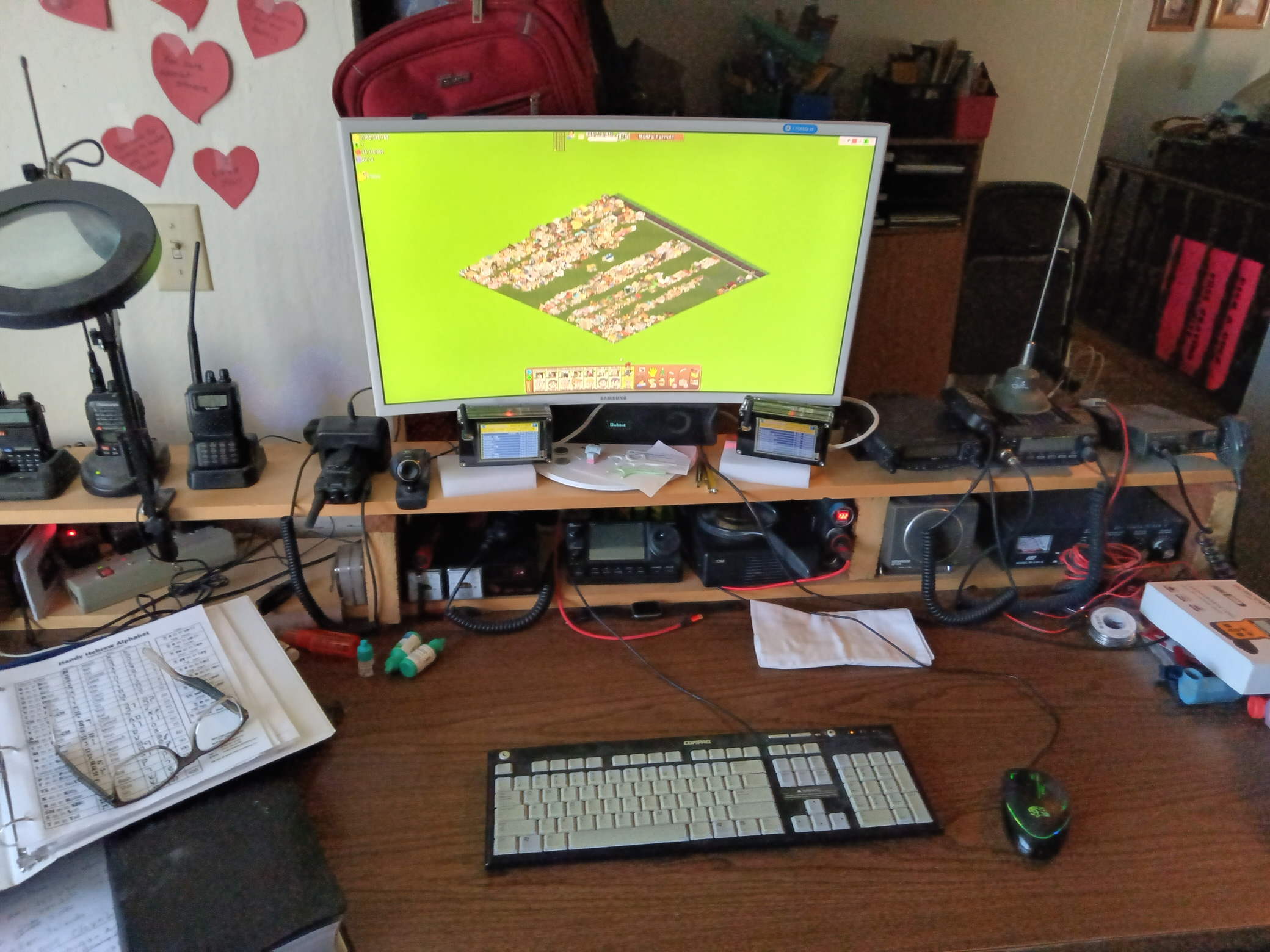
MY STORY
I enjoy listening to radios. I especially enjoy listening to stations I am pretty sure no one else in my neighborhood is listening. In elementary school I listened to KPEN, the first FM station in San Francisco. My parents had an old radio next to the front door that had shortwave as well as AM. I heard men talking back and forth. I have had an interest in Amateur Radio since I first found the men talking were Amateur (Hams) on the radio in High School. I was first licensed during my last quarter of college in September, 1970. I married Karen, in October, and Ben was born during the next year. I had a 2 year, Novice ticket and used a separate receiver and EICO 90 Watt, tuned down to 75 watts, only on CW (Morse Code). The FCC liked to give out Pink Slips and I found I didn't like CW or the attitude of the band. My license lapsed. I was one of the first No-code Tech's, once my children moved out of the house. I was WN6DVV in 1970, KC6ZKD in 1991, AC6TW for a few months in 1996, and will probably end my career as AC6ZZ. I went to a big high school with a big Amateur Radio tower and in Electronics theory there was a plenty big room with a glass door where I could see all the ham equipment. My instructor was Mr. Jack Glessner, Trustee, club callsign W6BAK (silentkeyhq@gmail.com). As I completed my college career I needed two units to graduate and took a radio class with Mr. Dwight West and to pass I needed to get my radio license. So I learned code and held a Novice ticket when I graduated.
In February, 2000, I acquired a Kenwood TS 430S (from my Elmer, Dave, N6YYM (SK)) the HF antenna Hustler 5-BTV trap Vertical on HF. In May, 2000, Karen and I purchased twin ICOM T81A quad-band VHF-UHF rigs in 2001 when she became KG6FPX,we talked frequently on 23 CM, but they were removed from our vehicle in January, 2004 during a convention. We replaced them with cell phones and have never gone back to rigs to contact each other. In June, 2007, I purchased a Yaesu, VX-3, which is a great little receiver, a bit light on transmit even to the three repeaters 20 miles away on Mt. Diablo, simplex is impossible. Karen uses the VX-3 to listen to the Giants Baseball games. I sold my Kenwood the others were permanetly removed from my shack. In 2012, I purchased an FT-60R for mobility with enough power to reach the repeater. The FT-60R is a basic, adequate rig and easily replaced at about $140. (Today, I would replace my FT-60R with FT-70R and go digital with Fusion.) In the summer of 2006, I rebuilt my HAM shack as I did in the Summer of 2017 and completely rebuilt my station in the Spring of 2021 including Anderson Power Poles. I currently use a SEC1235M power supply which charges my Walmart 26R battery to be able to communicate in a true emergency without the need of the power grid. My good wife Karen, purchased a Yaesu FT 8900 quad band 10, 6, 2 and .73 cm FM rig for Christmas 2009. In the summer of 2013, I bought an Alinco DR-235MK// which put me on 222 Mhz, completing all bands from 160 meters to .73 meters. My most recent and versatile rig is a Wouxan KG-UV3D, 2-222 HT. In October, 2016, I purchased a Baofeng UV-5R for $26. It was too cheap not to buy and it is in my Go-bag. All my antennas except my HF wires are in my attic. I also added several VHF antennas are sitting in my attic on a 2x10 foot steel plate. In June, 2017 I acquired a ICOM IC-7100 all band, all mode rig with an all band HF rig including a AT-100 Pro// Autotuner. On January 09, 2019 I made my first D-STAR communication with the help of Jim, K6JM and Terry, N8LN on the phone and Rick, KM6IXB my digital Elmer. I feel very fortunate to be able to have all this equipment at the ready. I received my first license in 1970. My station was an EICO 90 watt, tuned down to 75 watts to stay legal in my Novice ticket. I had to change crystals (xtal) each time I wanted to change frequencies and then had to retune the grids. It was a pain and I didn't care for the FCC that was famous for their pink slips. When I got back into the hobby, I determined to go transistor, 12 volt and be flat foot. I do not use amplifiers outside the rig themselves. I have all the radios I want and need but continue to experiment on antennas. In 1979 the Barstow Search and Rescue team found me a step from dead in the desert with a broken leg. I do not have the energy or health to be part of the Search and Rescue here in Contra Costa County, but I am FEMA certified and retired from the Sheriff's Emergency Radio Team, CERT, and SATERN. I usually check into a number of nets each week on Monday, and Thursday night. I check into the Tuesday digi net. Wednesday I try to check into the Red Cross net. You can see the details for these nets below.

I am cleaning out my HAM shack of the following:
Ok, so I am a HAM (Amateur Radio)
What makes me different from say CITIZEN'S BAND or CB? CB a narrow band, About 500 KHz (0.4600 MHz) wide on 11 metres, around 27 MHz on your radio dial. They are limited, legally, to 40 narrow frequencies. In the United States of America CBers can use a transceiver of less than four (4) watts output without a license of any kind. While there are many very nice CBers, the Band is known for profanity and crudeness. Amateur's are regulated both by law and are self-regulated so we talk as ladies and gentlemen. The CB band itself is quirky. One day the band can talk around the country with no problem, an hour later, it is hard to talk a block away. The band just "goes away".
On April 15, 2000 the United States went from Six classes to Three classes of licenses. All Morse Code Requirements were removed in the last days of 2006. Code is no longer a requirement for any FCC Amateur Radio license in the USA.
*. Novice License (retired) unnecessary when code was removed from requirements
1. The Technician License requires no code passing Element 2 (a 35 question theory test) YOU ARE 35 QUESTIONS FROM AN AMATEUR RADIO LICENSE!
*. Technician+ (retired) Novice 5 WPM Code and pass General test
2. The General Class License requires passing Elements 2 and 3. Test Three is a 35-question theory test. This license grants privileges for all modes on most HF and all V/UHF bands
*. Advanced (retired) I was Advanced for less than an hour between passsing 13 wpm and 20 wpm tests.
3. The Extra Class requires passing Elements 2, 3 and 4. Element four is a 50 question test. This license grants all privileges on all Amateur bands. It allows all frequencies and modes available in the USA.
*. Personal comment: I took all 8 tests (5, 13, 20 wpm code and five HAM levels before FCC simplified) Don't be afraid of the Technician test. As a VE (Volunteer Examiner) most people pass THE TECHNICIAN TEST once they take it once or twice. Don't strive to get 100% on the test, it is pass/fail. Take the test and get on the air!
RECOMMENDED FREE ONLINE CLASS
David Castler KE0OG
HAMSTUDY: ALL THREE LEVELS
WB6NU'S NEW COURSE
WAVE TALKERS
ONE STOP LICENSE
HAM UNIVERSE
HAM RADIO LICENSE MANUAL
RECOMMENDED PRE-TEST SET
eham Test Site
The W5YI Group
QRZ TESTS
HAM EXAM
advertisment: HAM TEST ONLINE
advertismment: STUDY 4 HAM TESTS
Lafayette, THIRD FRIDAY EACH MONTH in NorCal
BENICIA SATURDAY HAM CRAM & TEST
STOCKTON HAM CRAM & TEST
old 50 minute video on REMOTE TESTING
TEST "LOCATIONS"
GOOD IFO FOR THE NEW HAM
Amateurs in the USA can use up to 1500 watts PEP and can use U.S. Amateur Radio HF Bands from 2200 meters (below the AM band) to light. I was given a Kenwood 2/440 rig I use in my car. Personally, I find HF to be distracting while driving. I also monitor a dozen repeaters on two metres each week. I am now on 40 meters, 20 meters, 2 meters, 135 cm band, 73 cm Band and D-STAR Reflectors at home.
Here is a quick list of all legal frequencies here in the United States:
Amateur (HAM) Frequencies
You will quickly notice there is a relationship between frequency and length of the wave.
One way to express this is Meter Length = 300/MHz
| HF BAND | LOW END OF BAND | HIGH END OF BAND |
| 2200 meters | 135.7 KHz | 137.8 KHz |
| 630 meters | 472 KHz | 479 KHz |
| HF BAND | LOW END OF BAND | HIGH END OF BAND |
| 160 meters | 01.800 MHz | 02.000 MHz |
| * 80 meters | 03.500 MHz | 04.000 MHz |
| * 60 meters | 05.330.5 MHz USB | Center of Ch 1 |
| * 60 meters | 05.346.5 MHz USB CW | Center of Ch 2 |
| * 60 meters | 05.357.0 MHz USB | Center of Ch 3 |
| * 60 meters | 05.371.5 MHz USB | Center of Ch 4 |
| * 60 meters | 05.403.5 MHz USB | Center of Ch 5 |
| * 40 meters | 07.000 MHz | 07.300 MHz |
| * 30 meters | 10.100 MHz | 10.150 MHz |
| * 20 meters | 14.000 MHz | 14.350 MHz |
| * 17 meters | 18.068 MHz | 18.168 MHz |
| * 15 meters | 21.000 MHz | 21.450 MHz |
| * 10 meters | 28.000 MHz | 29.700 MHz |
| _08 meters | 40.660 MHz | EXPERIMENTAL |
| VHF BAND | LOW END OF BAND | HIGH END OF BAND |
| *006 meters | 050.000 MHz | 054.000 MHz |
| *002 meters | 144.000 MHz | 148.000 MHz |
| *1.25 meters | 222.000 MHz | 225.000 MHz |
| UHF BAND | LOW END OF BAND | HIGH END OF BAND | |
| *070 centimeters | 0420.000 MHz | 0450.000 MHz | |
| 033 centimeters | 0902.000 MHz | 0928.000 MHz | |
| 023 centimeters | 1240.000 MHz | 1300.000 MHz | 1-2 GHz L Satellite Band |
| 013 centimeters | 2300.000 MHz | 2450.000 MHz | 2-4 GHz S Satellite Band |
| 0009 centimeters | 3300.000 MHz | 3500.000 MHz | S Band (FCC delete in 2021) |
| 005 centimeters | 5650.000 MHz | 5925.000 MHz | 4-8 GHz C Satellite Band |
| 003 centimeters | 10,000.00 MHz | 10,500.00 MHz | 8-12 GHz X Satellite Band |
| 12-18 GHz Ku Satellite Band | |||
| 01.2 centimeters | 24,000.00 MHz | 24,2500.00 MHz | 18-27 GHz K Satellite Band |
| 27-40 GHz Ka Satellite Band |
Definitions of the Letter bands
| 006 millimeters | 47.000 GHz | 47.200 GHz | 40-75 GHz V Satellite Band |
| 004 millimeters | 75.500 GHz | 81.000 GHz | 75-110 GHz W Satellite Band |
| 02.5 millimeters | 119.980 GHz | 120.020 GHz | 110-300 GHz mm Satellite Band |
| 002 millimeters | 142 GHz | 149 GHz | mm Band |
| 001 millimeters | 241. GHz | 250 GHz | mm Band |
| All Frequencies | 300 GHz | Infinity and beyond |
THERE ARE SEVERAL FREE TO USE BANDS WITH NO LICENSE OR IN THE CASE OF GMRS NO TEST LICENSE REQUIRED in the USA
CB (Citizens Band Radio Service (CBRS))
There are 40 channels around 27 MHz. CB FREQENCIES
FRS (Family Radio Service) BAND
462 and 467 MHz. FRS/GMRS FREQUENCIES
GMRS(General Mobile Radio Service) GMRS BAND DOES NOT REQUIRE A TEST BUT A FEE FOR LICENSE
462 and 467 MHz. GMRS FREQUENCIES & FCC GMRS DETAILS
MURS (Multi-Use Radio Service) FCC MURS DETAILS There are five MURS channels and the channels are either 11.25 kHz or 20.00 kHz each. The channel frequencies and (bandwidth) include the following:
151.820 MHz (11.25 kHz)
151.880 MHz (11.25 kHz)
151.940 MHz (11.25 kHz)
154.570 MHz (20.00 kHz)
154.600 MHz (20.00 kHz)
![[IMAGE]](http:./ARRL FREQUENCY BANDS 2019.jpg)
This site is where you can check the time for UTC Clocks and Computers
UTC to CALIFORNIA TIME
BAND CONDITIONS
|
I typed several versions of this in the last week and had multiple people tell me it was new to them. As an ancient, old HAM I remember crystals. -- "When bands were "developed" they used crystals. 2x 1.8 MHz (160 meters) is 3.8 MHz = (80 meters) each band is the next harmonic of 1.8 MHz. It is easier with 3.5 MHz = 80 meters. x2 is 7 MHz = 40 meters (2x and 1/2) 14=20 and 28 MHz =10 meters. Once I found this pattern, I could figure out the rest of the frequencies. Not as clean and clear but 2x28 is almost 50 = 6 meters and 3x50 is about 144-148 2 meters. The third harmonic of 2 meters is 70 cm. This may be more energy than just memorizing the bands, but it is a pattern that may get you out of a jam on the test."
|
|
1. Usually the lower portion of the band is CW and digital, top is Phone (some bands allow phone and digital across the whole band). 2. For single side band, 30 meters and below are lower side band for phone. Above 30 meters is upper side band for phone. 3. Remember the "weird bands" are 125cm, 12 meter, 17 meter, 30 meter, 60 meter, 630 meter, 2,200 meter. They have different power limits, modes, channels, etc. |
|
The US and UK have different bands and frequencies. I would love to see the US include a 4 meter band around 70 MHz. My IC-7100 will receive and transmit on this frequency and it is half way between 6 and 2 meter bands.
|
135.7 - 137.8 KHz New band, Military use for Sub to shore. More experimental than useful. Antenna is half the distance of 5k run
472 - 479 KHz = New band. More experimental than useful. Just below AM band. No data at this time.
000.535 - 1.800 = 106 CHANNELS ON COMMERCIAL AM BAND
001.800 - 2.000 = 160 METER BAND (Immediately above AM band. Haven't attempted to monitor since high school.)
Beginning of High Frequency (HF) Band. 3 to 30 MHz but they usually throw in 160 meters into HF
003.500 - 4.000 = 80 METER BAND (Many days can talk to TX from CA, 132 foot dipole antenna) Better at night in summer.
005.332 - 5.405 = 60 METER BAND (Five channels, specifically for Alaska. Maximum power 50 watts. every US GENERAL/EXTRA Ham can use)
007.000 - 7.300 = 40 METER BAND (Excellent band, interference from International radio, 66 foot dipole antenna) Better at night
010.00 - 10.150 = 30 METER BAND (CW and digital modes only)
014.00 - 14.350 = 20 METER BAND (My favorite HF band, Round the world band)
18.068 - 18.168 = 17 METER BAND
21.000 - 21.450 = 15 METER BAND (10, 15 and 20 Meter band depending on which band is open)
24.890 - 24.980 = 12 METER BAND
26.965-27.405 = 11 meter, Citizen Band, no license needed
28.000 - 29.700 = 10 METER BAND (Round the world or not at all) Better in day, and summer
End of High Frequency (HF) Band
Beginning of Very High Frequency (VHF) Band. 30 to 300 MHz
50.000 - 53.999 = 6 METER BAND (Ch 1 on the old TV) CALLED THE MAGIC BAND, DEAD AND THEN YOU ARE TALKING THE COUNTRY.
6 meter, K7AGE
6 METER BAND PLAN
70.000-70.500 England and few nations allow Amateurs in this four meter band, between this TV band (Not a US permitted HAM band)
88.000 - 107.900 100 CHANNELS OF FM RADIO BAND
144.00 - 148.00 = 2 METER BAND (many nets and arguably the most used band)
174.00 - 215.999 - TV CHANNEL 7-13
219.00 - 225.00 = 1.25 METER BAND , (I enjoy this quiet band and have two rigs)
END OF VHF
Beginning of Ultra High Frequency, UHF. 300 to 3000 MHz
300.00 = technically all frequencies above 300 Mhz are less than one meter, or microwave.
430.00 - 450.00 = 0.73 METER BAND (Northern California is very limited on this band because of military use)
462.5625-462.7125, 467.5625-476.7125 Family Radio Service (FRS), no license needed, 0.5 or 2 WATTS depending on channel, FIXED ANTENNA
470.00 - 806.00 TV CHANNEL 14-69
902.00 - 928.00 = 0.33 METER BAND (I have never used this band. It is the ATV uplink frequency. Verizon and police are all around this band)
1240.0 - 1300.0 = 0.23 METER BAND (Loved this band until all my equipment was stolen, no static, low power needed.) (.5-1.5 GHz - L or Long wave)
2300.00-2450.00 = 0.13 METER BAND (This band has many in-home wireless phones, wifi, Bluetooth, low power, short distance unless mountain top or Moon bounce) (2-4 GHz - S or Short wave)
END OF UHF
Beginning of Super High Frequency, SHF 3000 MHz to 30,000 MHz
10,000 - 10,500 = 0.03 METER BAND (homebrew equipment, dish antenna, low power, short distance unless on mt top or Moon bounce) (8-12 GHz - K for Crosshair)
TO LIGHT AND BEYOND Believe all frequencies above 500 Ghz are open for experimental use
THERE ARE SEVERAL FREE TO USE WITH NO LICENSE FREQUENCIES in the USA
CB (CITIZEN BAND)
There are 40 channels around 27 MHz. CB FREQENCIES
FRS (Family Radio Service) BAND*
462 and 467 MHz. FRS/GMRS FREQUENCIES
MURS (Multi-Use Radio Service) FCC comments There are five MURS channels and the channels are either 11.25 kHz or 20.00 kHz each. The channel frequencies and (bandwidth) include the following:
151.820 MHz (11.25 kHz)
151.880 MHz (11.25 kHz)
151.940 MHz (11.25 kHz)
154.570 MHz (20.00 kHz)
154.600 MHz (20.00 kHz)
Personally, I do not scan for police and fire. I can, I don't unless there is Police or fire action I can see. Next to the comment about "Oh, so you are a CB'er? People ask if I scan for Police and fire? I do live close enough to an emergency helicopter site, I listen to Air/Ground talk while they are on the ground, a football field away with my house shaking. But, no, I find Police and Fire boring. I am into Amateur Radio and scanning.
What is the purpose of Amateur Radio?
Amateur Radio provides the following:
1) Emergency communication, somewhere in my junk is a certificate from the American Red Cross indicating I worked in the Oakland, California fire of 1991.
2) Advancement of the radio art, improved circuits;
3) Communications and technical phases of the art, special-training exercises, field days;
4) Trained operators and technicians, self-education in intercommunication and fixing radios. We help on Jog-a-thons, 50-mile horse trips, parades, and other once-in-a-while community events that need communication.
5) International good-will, radio waves don't stop at borders, they travel the world and solar system.
*) Anthony Stanton, AC6GM suggested I add a sixth purpose for Amateur Radio. It is fun, and it is fun talking down the street or around the world. unlike ladies that stitch in their homes alone, Amateur's can sit at home (or be on the road) and talk to others about the hobby or anything else we wish.
Why do people get involved in Amateur Radio?
It is said that there are as many reason for getting into amateur radio as there are Amateurs. Some do it to while away the long hours of driving trucks. Several Amateur's I have come to really appreciate drive all night from Reno, Nevada to Hayward, CA and home each evening. They can stay on the same repeater most of the way. For 10 years I had a paper route and would listen and talk on the same repeater while I drove my route. Another Amateur got his license to augment his cell phone while skiing the Sierras. Recently, a gentleman became a HAM to work on the Iditarod.
I got my license just to prove to myself that I could do it, and to have intelligent conversation with someone other than a sixth grader. I love my middle grade class, but was looking for intelligent adult conversation. My wife, Karen, took her test and got into Radio just to talk to me.
The Amateur's Code: The Radio Amateur is: N1NKM
CONSIDERATE...never knowingly operates in such a way as to lessen the pleasure of others.
LOYAL...offers loyalty, encouragement and support to other amateurs, local clubs, and the American Radio Relay League, through which Amateur Radio in the United States is represented nationally and internationally.
PROGRESSIVE...with knowledge abreast of science, a well-built and efficient station and operation above reproach.
FRIENDLY...slow and patient operating when requested; friendly advice and counsel to the beginner; kindly assistance, cooperation and consideration for the interests of others. These are the hallmarks of the amateur spirit.
BALANCED...radio is an avocation, never interfering with duties owed to family, job, school or community.
PATRIOTIC...station and skill always ready for service to country and community. --The original Amateur's Code was written by Paul M. Segal, W9EEA, in 1928.
So what are the types of things "we" do in Amateur Radio?
The following short paragraphs describe some of what a Licensed Radio Amateur can do in the United States. I would love to hear other uses I have neglected to mention.
ANTENNAS Buying and Experimenting with antennas trying to get the most out of an antenna
BAND (SPECIFIC) BAND ANTENNA
40 METER FISHING POLE ANTENNA
20M homebrew w/Directions
COMET CX333 TRIBAND
BASE ANTENNA
ATTIC ANTENNAS
80 METER ANTENNA
COBRA ANTENNAS
102" WHIP
BOOKS ARTICLES URLS
ANTENNA PAGE
OLD HAM CALL SIGNS
HAM CALL: OLD CALL SIGNS
END FED ANTENNAS
END FED EARCHI
EFHW-8010 RECOMMENDED
CLASSIC END FED
Alpha, end fed $169
LNR 20m ANTENNA- RECOMMENDED
LNR 40m ANTENNA- RECOMMENDED
MICHAEL'S 80-6
*hfkits.com/product/10-15-20-40
HOA BUSTER ANTENNAS
TIGHT SPACE VIDEO
ATTIC ANTENNAS
LOOP ANTENNA
Isotron
ZEROFIVE
FLAG POLE ANTENNA
STEALTH HF ANTENNAS
dipole mount
Stealth Gutter Antenna
MY ANTENNA
FLAGPOLE ANTENNAS
ED FONG TRI-BAND
ED FONG SALES
APARTMENT 40-2 ANTENNA
HF HOA HIDDEN ANTENNA
Ask Dave KE0OG
HOMEBREW ANTENNA HELPS
NE SURPLUS
FB ANTENNA PAGE
WOLF RIVER COILS
END FED EARCHI
J-pole Comparison
2/440 J-pole
*THE ANTENNA FARM
VK1AD UNIQUE ANTENNAS
GET OUT OF THE SHACK
LOOP ANTENNA
6 METER LOOP
LOOP ANTENNA
Ciro Mazzoni Radiocomunicazioni
LOOP ANTENNA
6 meterloop
KI6NAZ CHAMELEON F-Loop VIDEO
MOBILE ANTENNA
ATAS120A QUERY
*
*
*mp1 ALL BAND HAM/TV ANTENNA
TEXAS BUG CATCHER
(40 TO 10 METER) ZS6BKW
HAMSTICK
2/6 OPEK MOBILE
AUTO ANTENNA
LARRY'S MOBILE 6-160 ANTENNA
MOBILE ANTENNA
DIAMOND330 RECOMMENDED
SCORPION ANTENNAS
TARHEEL 40A-HP
102" WHIP
MULTIBAND HF ANTENNA
6-40 single wire
40-10 SLINKY
HUSTLER 5-BTV SETUP
HUSTLER ANTENNA SYSTEMS
HUSTLER 6BTV
80-10
MFJ $119 40-6M
ALPHA ANTENNAS
HOMEBREW 80-10
WONDERWAND UK
CHEAP 5 BAND HF
RECOMENDED MULTI-BAND
GAP TITAN HF RECOMMENDED
BUCKMASTER DX
*KISS ANTENNA
*hvt-100 7-430
TENNADYNE.COM
MY ANTENNA
EMCOMM2, Chameleon Antenna
ZS6BKW
UK PRO-ANTENNA
TITAN DX
PORTABLE AND FIELD ANTENNA
Deploy-Anywhere Vertical HF
HAMSTICK
6-160 RECON
OPEK HVT-400B - 8 Band
*EAGLE ONE VERTICAL
OPEK HVT-400B - 8 Band
SQUID POLE
VK1AD UNIQUE ANTENNAS
*SUPER HF ANTENNA
BUDDIPOLE
QRP (see HOA)
$15 QRP VERTICAL
DISH 2 METER
HF HOA HIDDEN ANTENNA
Ask Dave KE0OG
TOWERS AND POLES
Texas Towers
JACKITE POLES
firestik.com
BUDDYPOLE
SOTABEAMS
SPIDERBEAM POLE
Shakespeare wonderpole
SATELLITE ANTENNA
AMSAT ANTENNA
TV SATELLITE DISH
3D ROTATORS
ELK SATELLITE
HINTS AND KINKS
EGG BEATER ANTENNA
UNIQUE AND FUNNY ANTENNAS
RAKE ANTENNA KK6USY
40-10 SLINKY
BEVERAGE ANTENNA
Stealth Gutter Antenna
WonderWand Wonderloop 750 from ML&S
ANTENNA SUPPORT
6 METER LAWN CHAIR
VHF/UHF/SHF ANTENNA
PA50-144HV-17-3-3CB
DISH 2 METER
ELK Antennas (Jim, AF6PU)
DX 105 to 500 Mhz
CHEAP ANTENNAS
4/6 METER ANTENNAS
M2
COMET CX333 TRIBAND
Smiley Antennas
CUSHCRAFT MA6B 6-20M
DIAMOND X-300 v/UHF
Cushcraft 19 el yagis
VIDEO HB9CV
BUILD HB9CV
10 element 2 meter
COMET CX333 TRIBAND
cute 2 meter
ANTENNA ANALYZER Antenna tools and parts
*COMET ANTENNA ANALYZER
LDG Z100A
ANTENNA ANALYZER
NANO NVA REVIEW
*ANTENNA ANALYZER
MR100 ANTENNA ANALYZER
MR100 ANTENNA ANALYZER $60
nanoVNA
HOME BUILT ANALYZER
SPECTRUM ANALYZER
*THE ANTENNA FARM
UTUBE JOSH KI6NEZ
#480 NANOVNA Made Simple
#314: How to use the NanoVNA
ICOM AH-4
*HOW-TO AH-4
ANTENNA DESIGN/TOOLS
JPOLE ANTENNA CALCULATOR
ANTENNA CALCULATOR
ANTENNA ANALYZER
Coil-Shortened Vertical Antenna Calculator
HF ANTENNA VIDEO
MULTIBAND HOMEBREW ANTENNA
COMET-NCG CAA-500 MKII
ANTENNA CALCULATOR
CHEAP ANTENNA POLE
100' LMR400 COAX
J-POLE Math
BETTER ANTENNA ANALYZER
RIG EXPERT SWR
CHEAP 433 MHz ANTENNA DESIGN
COMET GP-9 VIDEO
TV antenna amp
Z-match
![[IMAGE]](./AMATEUR 07 ANTENNA.jpg)
AMATEUR TELEVISION - ATV
YouTube -- Media MDARC
20:00 BATC -- /nick AC6ZZ
WHEREBY.COM TV
THURS 20:00 147.060 MHz. --100.0 (Audio only)
BATCATV
*HAM NATION
*HAM NATION WED 6PM PT
AFTER SHOW 7pm REF014C
W5KUB TV
W5KUB FACEBOOK
APRS Automatic Position Reporting System. Frequency is frequently on 146.390. This uses GPS or Cell phones to tell your location and show where all the other APRS HAMs are in the same 50 mile area.
GETTING STARTED IN APRS
If you know the call sign of a HAM, you can follow him to work or anywhere, if he is using APRS
How to set up APRS
ISS APRS video
APRS PRO
APRS Voice Alert
ISS APRS
ASTRONOMY
Sun Spots
EME, Earth Moon Earth, takes location and distance from the earth to use effectively.
1.8 METER FOLDING DISH
BALLOONS
PEORIA BALLOON
Mt Carmel High School Radio Club balloon launch
AMATEUR RADIO HIGH ALTITUDE BALLOONING
iHAB-7
QSO ON PARACHUTE
ARHAB
BAND/MULTIBAND
FT-891
FT-817ND
FT-857D
FT-450D
BAOFENG $215 ALL HF BAND
TYT9000D
AMAZON 14g DC wire
DIAMOND ANTENNAS
Diamond Screwdriver SD330-3-8
TARHEEL MULTIBAND ANTENNAS
160 Meter Band
80 Meter Band
40 Meter Band
40 METER FISHING POLE ANTENNA
20 Meter Band
20m 2w RIG
20M homebrew w/Directions
17 Meter Band
12 Meter Band
11 Meter Band [CB--NOT A HAM BAND]
COPPER ELECTRONICS
UNIDEN BEARTRACKER 885
102"
10 Meter Band
10 REFERENCE N6SPP
10-10
STRYKER
20 links to 10m
6 Meter Band
six meters the magic band 50-54mhz
6 M homebrew
6m JUNGLE ANTENNA
1/2" ANTENNA
2 Meter Band
COMPARE 2 HT's
VX-3 software
CHEAP RIGS
MARIN RPTRS
147.195 N6ICW SACTO
QUEEN CREEK CLUB
ELKO REPEATERS
CALAVERAS COUNTY REPEATERS
1.25 Meter (135 cm) Band
CA 220 REPEATERS
BTECH MINI UV-2501+220
TYT 220 55watt
BCM-220 MHz 1.25m Mobile Radio
UV-5X3
220 PDF
220 BRIDGECOM
COMET CX333 TRIBAND
222 J-POLE
TRIPLEXERS
PulseLarsen NMO220B
EBAY 222 ANTENNA
MFJ 222 ANTENNA
-->
MICROWAVE BANDS
70 cm Band
33 cm Band
23 cm Band
ALINCO DJ-G7T
SATELLITE DISH FOR 23CM
13, 9 & 5cm bands
BEEPER FOR iC-705
AREDN MESH NETWORK
5.1 to 5.8 GHz POWER AMP
BAND CONDITIONS One day I can turn on my transceiver and talk to the world. It all depends on the number of sun spots. Another day, I can hardly make a signal off my antenna wire to a OM 1/2 mile down the road. Some enjoy fielding band conditions using various methods. See Beacons.
BAND CONDITIONS
BAND PLAN There are more than 700,000 Amateurs in the US and millions more about the planet. Furthermore there are many modes, AM, FM, SSB, digital, FT8, CW, Slow Scan TV, Fast Scan TV, uplink and downlink satellite and many other modes. The FCC gives us the band, we need or organize the band to make everyone happy.
BAND PLAN OVERVIEW
ARRL BAND PLAN
BAND PLAN 10 METER
BAND PLAN 6 METER
BAND PLAN 2 METER
BAND PLAN 135 CM
BAND PLAN 70CM
BAREFOOT Much like QRP, a HAM determines not to use anything except the equipment he has. If my rig puts out 100 watts, I use 100 watts. One can and many Amateurs do, use a "heater" or Linear Amplifier to knock the power up to legal maximum of 1000 watts. If you run barefoot, you run with 1, 5, or 100 watts of the rig, without a linear amp.
BEACONS Unlike standard AM and FM, shortwave people/stations and bands come and go on the radio. Sometimes we tune down a band and hear nothing. We do not know if there is nothing on, or the band is dead. A quick way to find out is to turn to a distant beacon or a satellite overhead and if we hear it, we are free to send a signal with a fair amont of certanty that someone will respond. There are times when the band is dead and no amount of CQ, will bring a station from around the corner much less around the world.
Finding low wattage Beacons around the country on all sorts of frequencies is exciting for some. Many of these stations are on 100 mw (this is equivelant to a toy) but are frequently placed on mountain tops. Finding distant radio stations and beacons are things anyone can do. But it is something Amateurs do, there are groups of Hams that report on what beacon and weak signal (station) they can hear and or make contact.
Luxembourg 60m beacon LX0HF
BEACONS
NCDXF BEACON
INTRO TO BEACONS
UN BEACON
BRAGGING
1. One of the many things that can be done for entertainment on Maui, Hawaii is taking a bike ride down Haleakala. This takes several hours to wake up, get to the main meeting area, eat breakfast and drive up the mountain. Once on top, hundreds of people have to wait for the sunrise. I took this time to turn on my 5 watt HT. I talked to all the Hawaiian islands in under 30 minutes. Even my wife was impressed.
2. Actual comment on Facebook. "Several days ago I talked 40 miles between Antioch and Vacaville on 145.520 simplex. Years ago while traveling to LA on I-5, I talked on one (1) watt [Yaesu VX-3] around 100 miles between a guy up in the mountains and my 70 mph car.
3. One Saturday evening, very late I flipped on my 20 meter rig just before falling in bed. I heard a station in Connecticut and we talked for five minutes before the band faded. Neither of us had exceptional equipment or antennas, and we were both more than surprised we covered the country like we were sitting in the same room.
4. There is a Maritime Net at noon most days. I felt myself lucky to talk to a 29 foot sailboat in the middle of the Pacific, headed toward South Asia.
MARITIME NET
5. I passed and received my Extra Class License back in the 20 WPM era. Never talk about it, but I wouldn't have it any-other way.
6. While the space shuttle was up, I listened to it contacting guys all over the country. One morning while throwing the Chronicle, guys in San Francisco got excited and I looked up to see the Shuttle between earth and sky in a non-earth-like purple glaze. It landed in Florida 15 minutes later.
7. I listen and can talk to satellites over head when I want.
BUDGET How much radio can one buy with as little money as possible
K8UA
Hundred dollar HAM
amateur (ham) radio on a budget
CHEAP CHINESE RIGS
BUY & SELL and play with different radios, transmitters, equipment and antennas. Before the Internet, there were Amateur Radio Nets specifically for buying and selling, but they have gone the way of the quill pen with the Internet.
ANDERSON POWER POLES
EBAY
e.ham
MFJ-461 INSTRUCTIONS
HATS
BUY CRYSTALS
POWER AND VOLTAGE METER
VOLTAGE METER
power splitter
(Bob)Heil(K9EID)earphones
PERFECT HEADSET/MIC
HANG YOUR MIC
DISCOUNT COMPUTERS
ANDERSON POWER POLES
BOSE AIRPLANE HEADSETS
American Communications; Ham & CB Equipment For Sale or Trade
Antique Radios for Sale
BUY SELL & TRADE CB GOODS
CB , Scanner , And Ham Radios For Sale Or Swap.
CB & HAM RADIO SALES
CB AND HAM RADIO EQUIPMENT FOR SALE OR TRADE
CB/Amateur Radio Communication Equipment Auction and Sales
Citizens band and Ham radio: Sale, Swap, Trade.
FREE OR FOR SALE CB & HAM RADIO PARTS AND OR OTHER ELECTRONICS
Ham operators of the world, Swap, Sell ,Trade
Ham Radio Buy, Sell, or Trade - U.S.
Ham Radio Buy, Sell, Trade- North America
Ham Radio Classifieds
HAM Radio Equipment For Sale
Ham Radio Equipment for sale or swap Discussion
Ham Radio Equipment for Sale or Wanted
Ham Radio Equipment for Sale or Wanted USA
Ham Radio For Sale
Ham Radio Homebrew Sales
Ham Radio Sales Worldwide
HAM RADIO AND SCANNERS CB RADIO PRIVATE SALES UK
Ham Radio Stop Classified Buy Sell Trade Wanted
Ham Radio Stuff for Sale or Trade
Ham Radio Swap & Classifieds
HAM RADIO SWAP SHOP
HEIL MICROPHONES
Int. amateur radio shopping mall
JOLLEY'S-CB-HAM- RADIO-ELECTRONICS -SWAP SHOP
JunkSale Amateur Radio
Mercatino del Radioamatore
Sales of amateur radio equipment accessories
Upper Midwest Amateur Radios for Sale or Swap
American Communications; Radio Equipment Buy, Sell, Trade
CALL-IN FREQUENCIES Each band has a particular frequency one can call and look for someone to talk. Another use of call-in is going to a meeting you are unfamiliar with the location, you can call-in a pre-designated frequency and have people give directions to make it to the location/meeting. This is related to SIMPLEX.
SIMPLEX FREQUENCIES
10 METER FM 29.600
6 METER CW 50.090
6 METER SSB 50.125
6 METER AM 50.400
6 METER FM 52.525
2 METER FM 146.52 in US (147.500 in UK)
1.25 METER FM 223.50
.72 METER FM 446.00
.23 METER FM 1294.5
CANADA As our world continues to get smaller, I talk to Jeff, VE6**, most Saturday afternoons on International D-STAR Net, and have Facebook friends across Canada and Australia.
NEW CLASS LICENSE IN CANADA
Frequencies
CITIZEN BAND(CB)/FAMILY RADIO SERVICE(FRS) and General Mobile Radio Service (GMRS) There are three bands that are not the same but related that need no test. Citizen's Band is in the 27 MHz area and FRS is in the 462-467 MHz both can be used by anyone without a license. Buy a rig, set it up, talk legally. GMRS is in the same band and many of the same channels as FRS but needs, in April 19, 2022, a $35(?) license but no test and is good for the entire family. It uses many of the same channels as the FRS but has more wattage and can do many of the same things as Amateur Radio.This is related to SIMPLEX. THIS IS NOT AMATEUR RADIO.
YOUTUBE CB
HT-CITIZEN BAND
COPPER ELECTRONICS
UNIDEN BEARTRACKER 885
FRS/GMRS COMBINED
FRS/GMRS CHANNEL.
5 THINGS TO KNOW ABOUT GMRS
MY GMRS
CHIRP is a free, open-source tool for programming certain amateur radios. We once programmed our computers, now we program our HT's. CHIRP, I could not find the meaning for this Acronym but the "C" stands for Chinese and the last letters, RP Radio Programming.
PROGRAM 888S
CHIRP FIRST STOP
CHIRP TUTORIAL
CHIRP TUTORIAL'
How2chirp FT-60R
DMR
SOFTWARE DOWNLOAD
PRACTICAL CHIRP FOR UV-5R T
WESTERN AMATEUR RADIO FRIENDS r
CHOKE a form of inductor used to keep noise down while allowing electricity through.
CHOKE
CLUBS HAMs mostly sit at home and talk to people we can't see. Occasionally, we find people that have the same interests as we do. There are Missionary Nets (which is an on-air club), QRP, which is very low power clubs, We have a Delta Amateur Radio Club (Delta ARC), which are guys close enough to drive once a month, Microwave, EME, Earth Moon, Earth groups, and on and on.
BARK
BENICIA CLUB
CCRA
DELTA ARC
LODI ARC
MT DIABLO ARC
STOCKTON ARC
PUGET SOUND ARC
MAP OF HAM LOCATIONS
North Hills Radio Club
K6IS
COAX Coaxial Cable is its proper name. A type of feed line with one conductor inside the other. While this is certainly part of parts or selling, I have chosen to put it in a separate column because everyone has their own choice of coax. On 1/19/2018 someone asked about a certain cable and got upwards of 100 replies on the Internet. Half serious and half laughing, your choice of Coax is close to a religion
WIRED COAX
COMMUNICATE Traffic and weather and clarity of transmission are frequently the topic of conversation. We rarely talk about politics or religion. If one doesn't use their "Ham Call" we won't talk to them by law. This afternoon, 8 September 2016, I heard MANY sirens and got on my 2 meter repeater and in one question, found out there is a grass fire five blocks away. Never got near me, but the sirens said it was close. Could tell my neighbors where the fire was and satisfy their minds.
SKYWARN
Survival Radio & Emergency Communications Ukraine
COMMUNICATE CLEARLY As we talk, people go "Huh?" and one learns to speak clearly. We don't want to "walk" on others transmitting at the same time. There are rules, call signs, "Q" calls, someone needs to run the nets, all these things take a bit of work to sound professional and communicate clearly.
PHONETIC ALPHABET
NATO PHONETIC
PHONETIC ALPHABET
CONTESTING. Some Amateurs enjoy Contesting OnAir Is one of several places I can get info on Contests. A second location, would be QST magazine put out by the ARRL. A third would be listening to other Amateurs talking about upcoming contests. In most contests the Amateur is trying to get as many other Amateurs on a certain frequency during a certain time frame. There us usually very little chit-chat. It is mostly pulling their call sign out of the static along with trading information on location and how clear they can be heard.
N3FJP CONTEST SOFTWARE
GRID SQUARES
ALL ABOUT CONTESTING
CONVENTIONS AND SWAP MEETS EACH FALL PACIFICON takes over a hotel for a weekend. Hundreds of HAMs come to learn and buy from vendors. A number of clubs have a once a month in good weather swap meet to trade and sell equipment and parts.
Quartzfest
PACIFICON
NVCOM
CW or CONTINUOUS WAVE, sometimes called MORSE CODE is no longer part of the HAM or Amateur Radio test. CW needs very little in the way of equipment and can be heard when no other information is coming through. Ham jargon would call an operator working CW, "using his fist". While one should never say "Never", I doubt I will ever use CW for entertainment purposes. A great story, a guy in Arizona broke his leg high on a mountain. He used a wire and his car battery to make a spark and thus sent a CW message. It was heard and he was rescued. Whether Beetoven
*LONG ISLAND CW CLUB
BOTA
No-Nonsense No-Nonsense Morse code Training
Learn Morse Code in 20 minutes: Classic US Army Training
Cootie Single Paddle Key
*VISUAL CW
LEARN CODE IN 2.5 HOURS
DING CODE
100 WORDS@ 20WPM
5 WPM COPY CODE
Q Codes
VIBROPLEX
TOP 100 WORDS @ 15
SK_CC
*CWOPS
LCWO
*MORSEDX.COM
UTUBE G4FON CODE
G4FON CODE TRAINER
LEARN AND HAVE FUN WITH CW
CW at Disneyland
HOW TO LEARN CW
VK PRACTICE CW
UTUBE LONG ISLAND CW
KENT PADDLE
CW Tree
CWget
CW PRACTICE
uTUBE LEARN CODE
K7QO CODE
K7QO
CODE TRANSLATOR
W1AW CW
KOCH METHOD
CW MACHINE
Learn Code
CW INTRODUCTION
CW_1
CW
LIDS
PREMERE CODE
Straight Key Century Club
CW video
AmateurHamRadioMorseCodeTrainer
CWops
LEARN CODE
MFJ-461 INSTRUCTIONS
$10 oscellator
LONG ISLAND CW CLUB
F.I.S.T. CLUB
MORSE CODE NINJA
MORSE CODE NINJA'
SKCC Member Operating Frequencies Suggested calling frequencies in Mhz:
1.813.5
3.530
3.550 *primary
7.038 *new
7.055 *primary
7.114 *newbie slow 7.120
10.120
14.050
14.114
18.080
21.050
21.114
24.910
28.050
28.114
50.090
144.070
DIGITAL TRANSMISSION. Along with CW, AM, FM, and SSB, there are multiple digital voice modes. DMR, D-STAR, and FUSION, are incompatible competing modes at least in 2024. (I use a Hotspot, Raspberry 3 and TYT 380 for DMR and a laptop with BlueDV software and my IC-7100 for D-STAR) This field and modes are exploding. DMR is Motorola. My ICOM, IC-7100 is a D-STAR rig. Fusion (C4FM) was developed by Yaesu. For old timers, this is very comparable to VCR and BETA systems. Another digital mode that is exploding on HF is FT8.
Quick story, I was at HRO (Ham Radio Outlet), about a mile from Disneyland, listening to D-STAR, A station in Florida was talking to Europe and we were listening on a rig about half the size of a pack of cigarettes in California. D-STAR has been around for more than a decade. A HT not much larger than a pack of cigarettes can now reach the world in digital FM clarity. There are now a plethora of digital modes that can be decoded by software and a laptop. My first two contacts from my home in California were to Germany and Tasmania in clear FM quality.
DIGITAL RADIO/PHONES. NEW IN 2020
Dual Mode Network Radio - Anysecu M-9000
Qingoo P3 4G LTE Android Network Radio
DIGITAL TRANSMISSION
ESPAK
REFLECTOR LINKS
XREFLECTOR
VISUAL DIGITAL MODES
GOOD OVERVIEW OF DIGITAL
M17
ALL ROUND DIGITAL
D-STAR This is one of four major digital modes with Walkie-Talkies (HT in Ham jargon)
D-STAR GATEWAY-REGISTER
QUADNET ARRAY
D-STAR, DMR, FUSION compare
PEANUT
ALABAMA xlx REFLECTORS
QUADNET ARRAY
D-STAR Satellite
D-STAR SPARROW
DSTAR HF
HRCC LINK
D-STAR REFLECTORS
D-STAR NETS
REF001 STATUS AND CONTROL
D-STAR HRCC NET
D-STAR for Dummies
D-STAR PROGRAMMING4 ID-31 and ID-51
REF, XRF, DCS, XLX
D-STAR USAGE MONITOR
USAGE MONITOR'
D-STAR 01
Youtube D-STAR
HT DSTAR
D-STAR INFO
WIKIPEDIA OVERVIEW OF D-STAR
D-STAR Youtube
google book
FACEBOOK
LIST OF D-STAR REPEATERS
URL REPEATER DIRECTORY
MDARC D-STAR
D-STAR W6CX
DSTAR DASHBOARD
HF D-STAR
EXPLAINING ROUTING
DR MODE
GUI map
Repeater Lists
D-STAR WW6BAY
HAMRADIO360
Ham Radio Deluxe(HRD)
HOW TO D-STAR
OVERVIEW OF IC-7100.
LIST OF D-STAR REPEATERS
D-STAR info
ALL D-STAR SETUP
PEANUT REGISTRATION
D-STAR REGISTRATION
D-STAR REGISTRATION
DMR is one of four major digital modes DMR means Digital Mobile Radio. I rarely listen to anything but 31012 on DMR. Enclosed below are some of the digital modes I personally use or have interest.
DMR REGISTRATION
**BRANDMEISTER.NETWORK
TGIF 192.168.0.189/
TGIF PROFILE
TGIF SIGNIN
*
*
**BRANDMEISTER.TALKGROUPS
DMR
DMR'
DMR SIGN UP NUMBER
**DMR TGIF NETWORK
**BRANDMEISTER dashboard
** DMR HOSELINE
CODE PLUG
DMR FOR DUMMIES
QUICK DMR EXPLAINED
DMR hotspot video
MIKLOR DMR TUTORIAL
DMR TUTORIAL
*
DONGLE an electronic device which plugs into another electronic device and makes the software or device operable. Examples can include wireless modems, hotspots, copy protect software devices, and adapters.
ALL ABOUT SOFTWARE
RTL-SDR "RADIO"
YOUTUBE: THE SMOKING APE
Radio Reference Frequencies
RTL-SDR DETAILS
ECHOLINK For years I have had ECHOLINK on my cell phone and use it when away from my radios and need to check into a net. In 2023 I am becoming aware it is a full mode of communication.
ECHOLINK OVERVIEW
EVERYTHING TO KNOW ABOUT ECHOLINK
ECHOLINK FOR DUMMIES
FAQ
ECHOLINK USER GUIDE
YOUTUBE ECHOLINK
YOUTUBE BRIDGECOM ECHOLINK
SMARTPHONE ECHOLINK
WITHOUT A RADIO R3CU HANK
FT8 I began hearing about FT8 several years ago. It is sweeping Amateur Radio HF with regular reports of US to Europe QSOs. Digital FT8 needs very little power, uses a laptop and software and one gets a line of code. No talking. Sounds boring.
BRUCE RICHARDS INTRO TO FT8
FT8 MANUAL
FT8 SOFTWARE
FT8 FREQUENCIES
50.313 is the main FT8 freq, FT4 main is 50.318
INTRO TO FT8
FT8 NET/PAGE
BASICS OF FT8
FUSION is Yaesu's answer to digital communicaiton. It is one of the major digital modes with radios. It is identified as C4FM transmission. WIRES-X is not the same but uniquely part of C4FM. I have WIRES which was replaced by WIRES-X and honestly have never used any of Yaesu's digital modes and have very little understanding in 2023.
FUSION ROOMS
FUSION
FUSION C4FM
DIGITAL TRANSMISSION USING LAPTOPS. Along with AM, FM, this mode is an alternative. This mode uses equipment I have around the house. Nothing unique is needed. Laptop downloads fldigi.com and sound goes to > transmitter > across air > to receiver > to laptop. We talk with our fingers, reading the text.
FLDIGI UPDATES
FLDIGI The Contra Costa Sheriff's Department Emergency Communication Unit uses FLdigi. I tried for two years to use this very complicated program, needing to download upgrades every week to a month. Good program but lots of unique parts and I finally walked away from the Unit and FLdigi.
FLDIGI
FLDIGI FILES
FLDIGI VIDEOS
FLMSG(bottom of page)
FLDIGI DOWNLOAD
FLDIGI SOFTWARE
W1JLK software
FLDIGI GATEWAY
WIKIDOC
P25 is the fourth important mode and used primarily but not exclusively in Police work. It is why you can no longer listen on the average scanner to police chatter. Some of the OM that designed P25 are HAMs and use this mode but I know less than nothing about this mode.
DIGITAL OTHER MODES
JT65
WB8NUT DIGITAL
PSK31 It is a keyboard to keyboard simplex not all that unlike RTTY
SYSTEM FUSION
WOLPHILINK
WOLPHILINK'
JS8Call
FSQ very similar to FLDIGI and can be downloaded there.
DIGITAL HOTSPOTS This is a working webpage and technically should be part of the Digital Transmission above. This is a little interface between my Digital radio whether DMR, D-STAR or Fusion and the Internet.
YOUTUBE HOTSPOT
HOTSPOT FREQUENCIES
SIGNALINK (connects rig to laptop)
PI-STAR ENCYCLOPEDIA
OPENSPOT2
THUMBDV
NW DONGLE
![[IMAGE]](http:./HOTSPOT 01.jpg)
DX is radio shorthand for Long Distance. While I have listened for years to HCJB in Ecuador, TWR in Bonaire, Radio Moscow and Radio Netherlands and many other stations. My best QSO, or conversation back and forth was late one Saturday evening, I turned on my transceiver and talked to a gentleman in Connecticut from California. When the Sun Spots are in Amateur Radio favor, I have talked many times to Texas on 20 meters.
CLIPPERTON ISLAND
DX MAPS Very cool visual site for long distance radio
GRID SQUARES
HOT SPOT MAP
DX_SUMMIT
WHAT IS ON MY SHORTWAVE RIG
WHAT IS ON SHORTWAVE
DX_PATTERN
NORTHERN CA DX FOUNDATION
50KW AM US STATIONS
We have always used a TV antenna instead of paying for cable. I have watched Channel 46 in Fresno, 36 in San Jose, Channel 50 in Santa Rosa, 22 in Rohnert Park, and Channel 2 in Redding and Reno (depending on how the antenna is turned). Karen can watch around 20 digital channels.
EARTH MOON EARTH (EME) One of the facets of Amateur Communication I am trying to learn everything about is EME. Bouncing a beam from my back yard to the moon and back, or to another station in Europe or South America. This usually takes some knowledge of Astronomy, excellent equipment, good ears and is frequently done in CW mode.
EME ON THE CHEAP
K7XQ's page
K2UYH's Newsletter
4.5 meter (14.5 feet), three band dish
W6/PA0ZN's page
EME on 10 watts
LIVECQ.EU which is a network or receivers looking for EME signals. Pick a loud one (-15 to -20) and tune to that frequency. LiveCQ will tell you if he is on JT65B or Q65A-60. Start with whatever 2M radio you have and WSJT-X. After you get the hang of it, then start fiddling with the funcube and MAP65, which will decode the whole band and either JT65B or Q65A-60.
EA8DBM EME CHAT
LIVECQ.EU
![[IMAGE]](http:./HAM EME.jpg)
ECHOLINK Electronic format I use on my cell phone but can be used from laptops. It turns my cell phone into a HT (walkie-talkie) and I can talk from anywhere with a cell tower connection to anywhere else in the world with a Echolink connection. I must have and use my FCC Amateur call sign when using my cell phone to Amateur repeater.
ECHOLINK QRP FRIENDS*>29618. Tuesday, December 26 at 7 PM EST. Sunday, December 31 at 9 AM UTC Worldwide. 73 Steve Turner G0HCR
ELMER Helping others become HAM's, this is also called an "Elmer". My elmer in HF was Dave, N6YYM, he was a retired painter by trade, and as good a HF man as I had the opportunity to know. Unfortunately, N6YYM went SK (Silent Key) in February, 2005, and I truly miss his friendship. I have been an elmer to several people over the years getting into Amateur radio at the VHF level.
EMERGENCY COMMUNICATION for 25 years I was a member of the Contra Costa RACES (ACS) group. I have a chit that tells me I worked the Oakland fire of '91. and passed the FEMA RADO course and IS-100, IS-200,and IS-700. We started as an Ad hoc group of friends and it has slowly evolved into a group of unpaid Sheriff officers that have to buy their own uniforms and use Sheriff radios. I am a radio man not a cop-wanta-be.
PULSEPOINT.ORG app for your phone
Documents
FEMA CLASSES
EMERGENCY DRILL ON LAKE TAHOE Be aware the term HF or High Frequency is a specialized term. It refers to what was once shortwave, between 3 and 30 MhZ.
NON-GOVT EMERGENCY COMMUNICATION CLUB/GROUPS A subset of government emergency communication would include churches and social group communication.
Latter Day Saints (Mormons) have a much larger group on the radio each week than the local government.
The Northern CA Salvation Army I check in to this net most Monday evenings along with about 50 others Hams and communities.
SBC
SBC DOC
EXPERIMENT with bands, circuits, ideas (as long as they are in Amateur approved frequency slots. I heard of two guys that took a 5 mw laser pointer, took it on one mountain, the other guy went over 100 miles distant to another mountain with a telescope and they communicated via CW with each other...using light not radio waves.
HAM RADIO WORKBENCH
FIX, REPAIR or MODIFY equipment
PARTS
AliExpress (slow boat from China
Digikey
EBAY
MOUSER
Tonys capacitor corner
ANDERSON POWER POLES
LEARN REPAIR
Mr Carlson's Old Time Lab
ICOM REPAIR
MODIFY ASTATIC D104
HAM REPAIR.COM
POWER METER/FREQUENCY COUNTER
JANKE ELECTRONICS WI
AFFLORDIBLE RADIO REPAIR C0LORADO
Bill Grassa
clairmont radio services
CLAIRMONT SKYLAND RADIO AND TV SERVICES
RADIO SHACK PRO-28
MODS.DK
MANUAL LIB
ICOM Michigan
HESTER ELECTRONICS - AL
RETEKESS V115
VIDEO REPAIR FT-897
VIDEO REPAIR FT-817ND
VIDEO REPAIR IC-7000
VIDEO REPAIR POWER SUPPLY #1
VIDEO REPAIR POWER SUPPLY#3
COMM-SHOP-Robbers Roost Ranch, 49901 Highway 14, Inyokern, CA 93527-Commshop-ca@outlook.com
UTUBE TROUBLESHOOT
HAM RADIO REPAIR Cal Fischer 214-476-5107
FOX HUNT CHALLENGE. Looking for a hidden transmitter that may or may not be moving.
ALL ABOUT FOXHUNTS
![[IMAGE]](http:./AMATEUR FOXHUNT.jpg) L
LFREQUENCY
AM RALLY
AM FREQUENCY
PACIFIC CREST FREQUENCIES
AIRPORT FREQUENCIES
GEOGRAPHY finding unique (strange to me) call signs and finding them on a map. Radio does not stop at national borders but is world wide.
* Karen and I spent a day on Bonaire and PJ4VHF in the Caribbean. with Trans-World Radio
* The QUEEN MARY in Long Beach, CA on the top deck has a marvelous station that has the original equipment as well as new equipment on all bands.
* KGEI . Redwood City, CA, 100 kw Far East Broadcasting Company, aimed at Mexico City (decades ago)
* DX Expeditions
* Travel Helps
NORTHERN CA DX FOUNDATION
GLOSSARY/DICTIONARY With more and more one day wonders, starting at 8:00 on Saturday and at 3:00 they have completed 35 questions, passed the test, but are more confused than knowledgable. Here is a list of terms
JAMECO GLOSSARY
ELECTRICAL SCHOOL GLOSSARY
HOBBY PROJECTS GLOSSARY
ICOM GLOSSARY
ARRL GLOSSARY
HIGH ALTITUDE BALLOONS. The University of Reno, launch NASA approved balloons, run mostly by HAMS, several times a year with They regularly reach 80,000 feet and the highest I know of reached 102,000 feet. It is cool to watch and listen to the Internet version of the 12 to 15 minute flight over mid-Nevada. See also iHAB-7 Search, "high altitude balloon" for alternate videos.
BALLOONS.
HF or High Frequency When I was a boy, HF was 99% of all there was in radio. In the early days of radio, HAMs used 0.5 to 2.0 MHz and everything above that was High Frequency. When I was in High School in the late 50's and 60's VHF was in its infancy. My instructor Mr. Jack Glessner laughed and said we would never go to the moon because we couldn't get a radio signal out of our atmosphere. VHF was the wild west in 1965. Today, HF is 3 to 30 MHz and most will include the 160 meter band at 1.8 to 2.0 MHz. These are the bands that talk around the country and world. VHF is clear, clean (usually) FM and digital most of the time. If you want to compare, AM radio is HF and FM is VHF. AM can be heard for hundreds of miles but is full of static and noise. FM travels 75 miles but is crystal clear. This is the same for Amateur Radio propagation.
This is what HF Amateur Radio sounds like listening from your computer
HISTORY OF AMATEUR RADIO I went to school in the 50's and was taught about the Heavyside Layer that bounced radio signals back to earth. We now have some 50,000 pieces of garbage in space and call it the Ionosphere. I remember my electronics teacher tell me that we would never put men in space because we needed radio communication and nothing would get through the Heavyside layer. Then we developed polarized microwaves that went though the Ionosphere easier than warm knife thru butter. When I first got into radio 2 meter (144-148 Mhz) was considered experimental and we used 450 ohm wire on our TV antennas.
HAMS WIN WWII
HAMS WIN WWII_2
FAMOUS HAMS
KPH
W6KPH/KFS
W6KPH VIDEO
HAM CALL: OLD CALL SIGNS
HUMOR
DIGITAL is a fairly new mode. I start on my radio or cell phone and it moves over internet or wires to another radio INTERNET HAM RADIO QSONET allows anyone to listen, and I believe anyone that obeys the rules can talk. FCC rules require all Amateurs to use their call sign every 10 minutes, but I don't think this is true online. (Anytime one goes on-air, we need a FCC license.
ALLSTAR NETWORK
ALLSTAR COMMUNITY
FREESTAR NETWORK
*ALLSTAR
IRLP is the Internet Radio Linking Project. This is a fairly new, form of HAM radio that is 1/2 over the air and 1/2 over the Internet. Using frequencies all Amateurs can use, they send a code and it turns on a repeater anywhere in the world an IRLP repeater is located. It is not unlike Alice stepping in a hole and finding herself in Wonderland. Going to work one morning I heard a gentleman sign on from Brussels and talk about the snow and rain outside his home, while we were wishing for some of his rain here in California.
IRLP LIST
QSO.NET-$39 AFTER 30 FREE DAYS, NOT SURE IF HAM LICENSE IS REQUIRED
QSONET
PEANUT
UTUBE PEANUT
INTRO ECHOLINK
COMPUTER ECHOLINK
I like to LISTEN or MONITOR or in Ham Jargon, "Sandbag". Shortwave is a world of space, police, fire and foreign radio stations, one never knows what we will hear when we turn on our radio.
I listen to the Two Meter Band on my way to work or working at my desk. This is a VHF frequency (144-148 MHz) that only requires a 19 1/4 inch (41 cm) antenna. When I commuted to Vallejo, I would listen to Dean W7LIG (SK), in Nevada many mornings (140 miles) and when I had something to add I could talk to him. I can listen to most transmissions over at least 100 mile radius on the repeater and there is almost no static.
On rainy days, it is not uncommon to know far more about the weather than even my weatherman as everyone reports in, where it is raining and where the accidents are on the freeway. You can't do this on the Internet.
With my Yaesu VX-3 I can scan for police reports, business bands. When I worked in Vallejo I was only about a mile from a major USA amusement park, I could scan for Bugs Bunny and the other characters singing. The other night, I heard several friends talking simplex on a legal, but non-authorized place on the band.
AIRCRAFT HF PACIFIC
AIRCRAFT CALIF FREQUENCIES
SFO-OAK HEAVY FREQUENCIES
UTUBE SOLUTION TO MYSTERIOUS SIGNALS
EMISSIONS NOMENCLATURE
Listening/Learning
HAWAII FREQUENCIES
HAWAII KH6RS MAUI REPEATERS
HI FREQUENCIES
AK FREQUENCIES
SHORTWAVE STATIONS
WYFR-Deceased
WEWN
HCJB
FEBC
TWR
WWRB INTERNET STATION
ALL RELIGIOUS BROADCASTERS
SPACE I enjoy LISTENING TO SPACE. I have a patch that indicates I listened to the Space Shuttle while in orbit. At any given time there are dozens of microsatellites that we can listen to everything from a beacon to talk to people a continent away. With the new International Space Station and the Phase/// satellite in orbit, I expect Amateurs will be talking on a regular basis into space. LISTEN IN ON AO-91 PASS ON JULY 3, 2018 Suitsat1 in April, 2013, took a decommissioned space suit, put a Ham radio inside and the suit was thrown out into space. I believe I heard it, which is a once in never experience.
Just for fun, SUITSAT1: took space suit and put a 5 watt HF that went aound the world for several days before battery went dead in 2013.
AMSAT
HISTORY OF HAMSAT
Space Station Crew Uses HAM Radio to Call Earth
LISTEN IN ON AO-91 PASS ON JULY 3, 2018
ALL HAM SATELLITES LISTED OVERHEAD
FLY-BYS
D-STAR SATELLITE
MAKE Satellite Tracker
RS44-1000 KM
CONTACT ISS
ARISS
JARGON
AC6V'S JARGON PAGE
LEARN
*UTUBE-STAN GIBILISCO
LICENSE/TICKET
FCC
FCC'
LOG: Once upon a time every HAM had a logbook and and had to show 10 hours of QSO's in order to renew their license. Those days are gone, but there are some who still enjoy showing how many stations they talked to in period of time, especially but not exclusively during contesting. Today, stations use QSL Cards to show they contacted stations. LOG: AGENCY, DAY, MODE, YEAR, TIME. With the advent of computers few use paper and pencil and many of these programs use incredibly complicated programming where some even knew what class of license and do most of the work themselves for contesting. i use QRZ LOGBOOK
LOGIC
YFKlog
XMlog
WA7S
QRZ LOGBOOK
KB3IFH ON FACEBOOK
MARS, Military Affiliate Radio System which as its name implies is based in military discipline and does a fine job sending messages among active service men and women and their families. MARS is a military net designed primarily for traffic passing but can do much more in an emergency like 9/11. The nets are run in the military manner, which is a lot more structured than most ham nets. Anyone can listen to the daily MARS nets and traffic on any shortwave receiver. The MARS frequencies are allocated to the military, and are usually located just outside the normal ham bands by a few kHz to maybe 100 kHz away. Amateur Rigs need to be adjusted at the factory to include MARS bands separate nets for ARMY, Navy and Air Force. [I appreciate the Military and support them but am not military and do not have MARS built into any of my rigs.]
If interested in ARMY MARS
If interested in NAVY, Coast Guard, Marines
If interested in Air Force MARS
MARS WIKI
MARS MAIN PAGE
MARS DIGITAL MODE
MISSION SUPPORT NETWORK
METEOR SHOWER
INTRODUCTION TO METEOR SHOWER
METRIC In the United States we use British units, Inches, Feet, Yards, Miles. Most of the world and expeically radio ues metrics. millimeter, centimeter, meter, kilometer. Thus 3500 kilohertz (KHz) is 3.5 megahertz (MHz). If I have an antenna that is 102" long, how many cm is in 102"? Especially with antennas we are constantly in the US moving between inches and cm. Please note the next division: millimeter.
CM to inches calculator
MILLIMETER MICROWAVE Amateur's can use frequencies from very low and long, to very high and short. My interest tends to be with the shorter wavelengths. I can't get enough of the microwave frequencies. Short, shortwave to microwave travel in straight lines, much like light. Light needs a reflector to make it "bounce" around a corner. There are many ways to reflect a radio wave. Some of these include, repeaters, using meteor ion trails, bouncing it off the Aurora Borealis (Northern Lights), reflected off the side of a mountain. Look up the following for more information:
Down East Microwave
SSB Electronics
ARRL 50 MHz +
Microwave Journal
W6AMT
METEOR SCATTER
SATELLITES
50MHZ and Above
K6MU
MICROWAVE OVEN TRANSMITTER
DISH PREAMP/LNA
AREDN MESH
SFWEM
NET In Amateur jargon, a Net is a convention where Amateurs meet at a certain time on a certain frequency. We never leave our shack (home.) All frequencies are in MHz. All times are in Pacific Time. A frequency like XRF757a is a D-STAR Reflector. A number like 31012 is a DMR Reflector. (00:00) or other numbers are UTC. I like to visit the following:
NETLOGGER
SUNDAY
10:10 (17:00) 10 Meters, 28,400 KHz, Every Day
14:00 (21:00)RASPBERRY URL THE RASPBERRY PI NET
--14:00 (10:00) QCWA Digital Net QUADNET ARRAY, QCWA FACEBOOK
--16:00 (23:00) QUADNET Young Operators Digital Voice Net)
17:00 (00:00) REF091C KB0ZSG INTERNATIONAL D-STAR NET
17:00 (00:00) XRF002a (00:00) D-STAR USER GROUP
--18:00 (02:00) QUADNET AMATEUR RADIO RVers DSTAR DIGITAL VOICE NET
19:30 (02:30) 144:240 NORTHERN CALIFORNIA SIMPLEX SSB
21:00 (04:00) 147.570 LDS BRENTWOOD 1/4 WARD SIMPEX (JAVIER KJ6PGY)
23:00 (06:00) WIN SYSTEM , INSOMNIAC NET
MONDAY
08:30 (23:30) _14.325 SATERN NET salvationarmyusa
10:10 (17:10) _28.400 10:10 NET ON 10
14:00 (21:00) REF038C *RASPBERRY PI DIGITAL NET
17:00 (00:00) REF056c AMERICAN LEGION NET
00:30 (18:30) TGIF320 HotSpot Raspberry Pi, SBC (Single Board Computer) and ZumSpot Net
19:00 (02:00) 147.165 STOCKTON-DELTA ARC (FT8900-7)
19:00 (02:00) 000000 GOTA NR5NN
19:35 (02:35) 147.735 CONTRA COSTA REPEATER ASSOCIATION (7:35 PM ON 7:35)
20:00 (03:00) 147.060 SATERN NET
20:00 (03:00) __7.282 BENICIA ARC
21:00 (04:00) REF014c NORCAL INFO TALK NET
21:00 (04:00) _3.9777 LSB WESTERN SATERN NET
23:00 (06:00) WIN SYSTEM , INSOMNIAC NET
TUESDAY
10:10 (17:10) _28.400 10:10 NET ON 10
15:00 (22:00) 21.365 NET
16:30 (23:30) QUADNET INDIANA NET
17:00 (00:00) 14.319 NET
18:00 (01:00) 8:00 PM CENTRAL TIME, AMATEUR RADIO ROUNTABLE
18:00 (01:00)ASTRONOMICAL NET, QUADNET ARRAY
18:30 (02:00) TTT NET, 223.500 SIMPLEX
19:00 (02:00) 10-7 NET, 28.405, WOODLAND
20:00 (03:00)147.060 ACS DIGITAL NET
WEDNESDAY
00:30 (8:30) MELBOURNE REF091C
08:30 (23:30) _14.325 SATERN NET salvationarmyusa
10:10 (17:10) _28.400 10:10 NET ON 10
18:00 (01:00) AMATEUR RADIO ASTRONOMY DIGITAL VOICE NET, QUADNET ARRAY
19:00 (02:00) 147.060 SKYWARN NET
19:30 (02:30) 147.735 laMarinda Net
19:30 (02:30) 144:240 NORTHERN CALIFORNIA SIMPLEX SSB
20:00 (03:00) 144.230 25-25 SIMPLEX NET USB
20:00 (03:00) 147.060 DARC NET
20:30 (03:30) 28.420 N6NA 10 METER RIVER CITY NET
21:00 (04:00) _3.9777 LSB WESTERN SATERN NET
23:00 (06:00) WIN SYSTEM , INSOMNIAC NET
24:00 (06:00) DIGITAL MIDNIGHT NET , DMR 320, D-STAR XRF307a
THURSDAY
01:30 (08:30) REF091C US NEWSLINE
10:10 (17:10) _28.400 10:10 NET ON 10
16:00 (21:00) REF056b KY D-STAR NET
16:00 (21:00) QUADNET KY D-STAR ALTERNATE FREQUENCY
18:00 (21:00) XRF021b CAN-NET
18:30 (21:30) REF014b ARES NET
18:30 (21:30) REF014b <"https://hrcc.link/connect.html">D-STAR HRCC NET
18:35 (21:35) 3.893 PLUS OR MINUS ACS HF NET
19:00 (02:00) XRF058a CERT/D-STAR NET
19:00 (02:00) 146.535 DARC SIMPLEX NET
19:20 (02:20) 147.735 CONTRA COSTA COUNTY EMERGENCY COMMUNICATIONS NET
19:30 (02:30) 147.060 MDARC NET
20:00 (03:00) ANTI-NET
20:00 (03:00) MDARC AMATEUR TELEVISION
21:00 (04:00) _3.9777 LSB WESTERN SATERN NET
19:00 **FOURTH THURSDAY DELTA AMATEUR RADIO CLUB-PITTSBURG
23:00 (06:00) WIN SYSTEM ,INSOMNIAC NET
FRIDAY
08:30 (23:30) _14.325 SATERN NET
10:10 (17:10) _28.400 10:10 NET ON 10
salvationarmyusa
18:30 (21:30) 147.060 NEW NET WITH GORDO LINKED
19:00 (22:00) 440.450 (25)W6KAP ERNIE IN VOLCANO NET
20:30 (03:30) 444.725 ANTIOCH FRIDAY NIGHT VHF NET
21:00 (04:00) _3.9777 LSB WESTERN SATERN NET
21:00 (04:00) QUADNET RXR NET
23:00 (06:00) WIN SYSTEM , INSOMNIAC NET
SATURDAY
08:30 (23:30) _14.325 SATERN NET
10:10 (17:10) _28.400 10:10 NET ON 10
15:00 (22:00) XLX 307d D-STAR USER GROUP
15:00 (22:00) XRF 757a D-STAR USER GROUP with Jeff
16:00 (23:00) REF091C (23:00) AUSTRALIA NEWS
21:00 (04:00) _3.9777 LSB WESTERN SATERN NET
23:00 (06:00) WIN SYSTEM , INSOMNIAC NET
MISCELLANEOUS
19:00 GOTA NR5NNMARITIME MOBILE SERVICE NETWORK
WEEKLY D-STAR NETS
DSTAR HF VOICE SCHEDULE
Sat PM 7:00 E (2300Z)
Sunday AM 10:00 E (1400Z Sunday)(Spend more time on each open band, and start on 80m)
Sunday PM 7:00 E (2300Z)
Check USB/LSB on freq to make sure the freq is clear.
SUNDAY AM, we start with 80m and work towards 6 meters.
06 mtrs 50.210 DV for 2 mins
10 mtrs 28.480 DV for 5 mins
12 mtrs 24.938 DV for 5 mins
15 mtrs 21.380 DV for 5 mins
17 mtrs 18.148 DV for 5 mins
20 mtrs 14.340 DV for 5 mins
40 mtrs 7.285(or another open freq) DV for 5 mins
75 mtrs 3.880 DV for 5 mins.
Net is Run via DStar Ref 30C for coordination.
LIST OF CANADIAN NETS
For the SCIENCE OF IT! Covers of Amateur Radio magazines I am currently using for a seminar include Counting Sun Spots in the January, 1998 QST magazine. Transmitting over 100 miles with a 5 mw laser pen between mountaintops in CQ/VHF, March, 1999. Many to most of the items on a radio like automatic volume control, Digital tuning. Repeaters if you live in smaller US towns for FM reception and much more come from Amateur's experiments.
MODE ALL MODES LISTED
AM RALLY
AM FREQUENCY
PACIFIC CREST FREQUENCIES
NOAA SUN SPOT PROGRESSION
MODEL PLANE can be found on six meters. It takes a license to use this band, so some of these ladies and gentlemen choose to become HAM's so they can use this and other bands to run their remote controlled vehicles. They can add a TV camera to their remote controlled vehicles on microwave, thus using two frequencies at one time.
MODEL AIRPLANE FREQUENCIES
AZ CLUBS/FIELDS
CA CLUBS/FIELDS
PLAY WITH NEW FREQUENCIES 1.25 METER BAND At one time most of my equipment was Yaesu. Now I use what is available for my pocket book. I use an Alinco DR 235 Mk /// and Wouxun 2/222 rig on 222 Mhz. I was strongly advised not to buy this rig, that "no one was on it." and sometimes that is true. But there are several repeaters in our area and a guy a mile or two away is frequently on. We have become fairly good friends and I never would have met him, had I not had this rig. I also have a Wouxan KG-UV3D, HT I find easier to hold, use and program.
SoCal/AZ 220 REPEATERS's page
PLAY WITH RADIOS
ICOM IC-7100, ALL BAND, ALL MODE INCLUDING D-STAR
Brand new to me as of July, 2017. Still don't have it on the air.
IC-7100 MANUAL
kv5r.com/ham-radio/2018-projects/7100-panadapter/
PANADAPTER
YAESU FT-8900, 10, 6, 2, .73 METER
My favorite rig when I am home. I can listen to two frequencies at the same time and usually do.
FT-8900 MANUAL
FT-8900
WIRES
WIRES OFF
FT 8800
KENWOOD TM-D700A, 2/440
This rig was given to me by KG6AUA and KG6ATN. At one time we, KG6FPX and I talked to them as we were all driving around after school. When a car was wrecked, they gave the rig to me and it has a super front end. This radio is installed permanently in my car and it pulls in simplex stations much clearer than any of my other rigs.
ALINCO DR 235 mk ///, 1.25 METER MONOBAND
It is on my desk. I use it when my Wouxun won't reach.
DR 235 MANUAL
DR 235 SERVICE MANUAL
YAESU FT 60R, 2/440 HT
I have had several FT-60(R) models over the years. Went to an emergency meeting one night and almost everyone in the room of 30 men had a FT-60. Excellent rig for 2/440.
WOUXUN KG-UV3D, 2/222 HT [ON LOAN]
Both my Wouxun and Baofeng are inexpensive Chinese rigs. I wanted to see how they had improved and use them in their own right. I frequently use this rig over my Alinco to be on a 222 net.
x108G
2/222 PROGRAMMING
Anytone triband
BAOFENG UV-5R, 2/440 HT
From Amazon to my door it was $31. It has almost no weight and fits in my pocket. I appreciate the rig has the entire commercial FM band as part of the radio. I have all kinds of frequencies in this for emergencies but also for going to the ball game. It is not Part 97 approved and I was uncomfortablel and gave it to a friend who listens to airplanes and other shortwave frequencies.
PARACHUTEMOBILE I have seen this multiple times recently. About 10 minutes per jump, listening to a guy jump from about 20,000 feet and talk to the ground.
PARACHUTEMOBILE
POWER SUPPLIES Very few transceivers use wall voltages. Tubes use around 300 volts and transistors use 12 VDC, the same as car voltages.
COOL POWER STRIP
OFF GRID POWER SUPPLY
battery cover
BATTERY BOX
Bioenno Power LiFePO4 Lithium Iron Phosphate Battery
BIOENNO CHARGER
Q-CODES Government uses 10 codes, "10-4." Amateur Radio has always used Q codes. QRP is low power. QTH is "What is your location?" This is Amateur radio jargon. These were developed back in the CW days and three letters were easier to send than all the letters in a comment or question.
Q Codes
Q Codes
QRP A footnote on CW. Some very hearty folk prefer what is known as QRP. These are transmitters with a maximum power of 5 watts. In a world of big radios and transmitters, they go small. I have a friend, AB6MB that rarely uses more than 2 watts and in a 1998 contest, "talked" to 12 states in 24 hours. By the way, he did this in the back of an old VW bus in a state park not far from our home. I heard of a contact between California and Japan using only 12 milliwatts and was powered by an AA battery in a tuna can!
FACEBOOK QRP
QRP SCHOOL
QRP URL
Peter Parker QRP VIDEO
QRP book
INTERNATIONAL QRP
QRP FREQUENCIES
QRP FREQUENCIES'
QRP FREQUENCIES"
QRP Q/A
Chinese HF rig_QRP
10-TEC QRP rig
qrpkits
BREADBOARD KITS
YoKits
Chinese HF rig_QRP
XIEGU 108G
VIDEO COMPARE
QRP ANTENNA/KITS
RISEN QRP CHINA
QRP GUYS
CRICKET40
PIXIE KITS
MINIMALIST QRP Using the fewest number of parts to make a RF signal another can hear.
MINIMALIST QRP
ULTRA QRP Whether a 5mw LASER or a 12 mw tuna can station Ultra stations never go over 1 watt and attempt to work on under 100 mw of power to talk to the world.
COLLECT QSL CARDS
![[IMAGE]](http:./AMATEUR QST CARD.PNG)
Example Card
Example of a QSL CARD
KA6LMS CARD
TIME CONVERTER
QTH -- WHERE ARE YOU
HAM-CALL MAP
QRZ WEBPAGE
QTH LOCATOR
RAGCHEW Have someone to talk to on sleeplcontess nights. One night I helped a fellow XYL (Previous Young Lady or married woman) who was having trouble with her medication. She is blind and she didn't know if she had taken too much or too little medication. We talked as I did my paper route for about half-an-hour until the possible crisis passed. I could have used my autopatch to call for emergency help half a state away.
RECEIVERS Commonly known as a radio. Most shortwave receivers are much fancier with a lot more nobs to clean the signal, but in short a receiver is a radio.
CountyComm GP-7 SSB Ad
CountyComm GP-7 SSB 0-30 MHz YOUTUBE
CountyComm GP-7 AM FM SSB CW YOUTUBE
SHORT WAVE LISTENING (SWL)
REGULATE We self-discipline ourselves. We have rules in the FCC Part 97. We must use our Amateur Radio license call sign at the beginning and every 10 minutes of talking. We don't swear. We don't play music. For a while, there was a guy in San Francisco that would sign on with a five minute, day, date, address, etc and etc. We tutored him, he continued, we ignored him and he went away. No one wants to transmit and get silence back. We regulate and keep our Ham frequency clean and legal.
REMOTE We can sit by the fire and put our transmitter high on top of a snowy mountain or anywhere else we would like to put ourselves and our transmitter.
RS-BA1 software
remotehams
AIRPLANES REMOTE CONTROL MODEL CARS/AIRPLANES. While there are a number of frequencies model airplanes can fly on, most are very limited. Some amateurs use the six-meter band which will allow some of these huge planes to travel fifty and more miles from where the control pilot stands with their controls.
REPAIR, SEE FIX AND REPAIR
JAHNKE ELECTRONICS
JANKE ELECTRONICS WI
AFFLORDIBLE RADIO REPAIR C0LORADO
Bill Grassa
CLAIRMONT SKYLAND RADIO AND TV SERVICES
UTUBE TROUBLESHOOT
REPEATERS is another form of Amateur Radio. Repeaters are "machines" on the top of towers, mountains or even satellites in space, there is one on the International Space Station, our dream is to have one on the Moon, that make communication of short, shortwave possible over long distances. Some repeaters allow an Amateur to connect with the phone grid. About once a week, I have a reason to call my wife. I can do that almost anywhere within 100 miles of home at no cost to me. With a cell phone in every pocket this is becoming antiquated but some repeaters keep a phone available.
CHEAP REPEATER
SET UP RIG 4 REPEATER
Mt. Diablo ARC
CCRA
NARCC's Page
Every Repeater in the US
NEVADA REPEATERS
PACIFIC RIM REPEATERS
RENO Repeaters
HAWAII RADIO FREQUENCIES
HAWAII REPEATERS
Ron Hashiro AH6RH/
147.195 N6ICW SACTO
SACTO OPEN REPEATERS
QUEEN CREEK CLUB
CA REPEATER LIST
KJG LIST OF CA REPEATERS
NARCC
ELKO REPEATERS
TEHACHAPI
BARSTOW
BAKERSFIELD
BENICIA REPEATER CLUB
MT. VACA REPEATERS
CA REPEATERS
GRID SQUARES
REPEATER SYSTEMS is another form of Amateur Radio. Repeaters are "machines" on the top of towers or mountains spaced a distance apart. There are military and emergency communication systems "across the backbone of the Sierras". There are at least two Amateur Radio systems spaced from mountain top to mountain top from San Diego to the Midwest and Canada.
WARA: WESTCOAST AMATEUR RADIO ASSOCIATION
CARLA
CCRA
SNARS
IRLP
WALA-MOSTLY LA
WIN SYSTEM
RF EXPOSURE CALCULATIONS
RF EXPOSURE CALCULATIONS
SATELLITES Satellites fly overhead every 90 minutes and are frequently closer than stations we are talking to on earth. Most classes of Licenses can talk to and from satellites legally. Many of the Astronauts and Cosmonauts have Amateur Licenses and talk back to earth. I have a patch that says I talked to one of the earlier space shuttles. You can also download satellite weather pictures.
COMMUNICATE 5 A BIRD
AMSAT
X-37B Space Plane Spotted by Satellite Tracker
ISS
AO-73
AO-85
AO-91
AO-92
HAT CREEK ARRAY
.jpg)
Satellite Antenna
MAKE SATELLITE TRACKER
SATELLITE TRACKER
![[IMAGE]](AMATEUR SATELLITE.jpg)
Image by Fred Cunha
SDR Software Defined Radio
Software Defined Radio (SDR) on Android Device
FUN CUBE DONGLE (SDR)
N3UJJ SDR
SUPPORT SDR
YOUTUBE BEGINNERS GUIDE 2 SDR
*
*
SIMPLEX it is like holding a conversation in the same room with someone. SIMPLEX is simple, We talk radio to radio without using high power, repeaters, or the internet, just two people and two radios. HF is almost 100% simplex. VHF/UHF has at least a dozen modes to talk to many at one time via repeater, digital, etc.
SIMPLEX FREQUENCIES
10 METER FM 29.600
6 METER CW 50.090
6 METER SSB 50.125
6 METER AM 50.400
6 METER FM 52.525
2 METER FM 146.52 in US (147.500 in UK)
1.25 METER FM 223.50
.72 METER FM 446.00
.23 METER FM 1294.5
SUMMITS/PARKS ON THE AIR takes two people one to be on top of the mountain and one at home or even another peak called a CHASER to listen and report they heard signal. SOTA SUMMITS OF THE AIR and POTA One of the newest names in radio. Previously known as MOUNTAINTOPPING and you may still see this term used from time to time.. Walking to the top of a mountain with all necessary gear (usually on their back)and spend hours talking to any and all people on the same time and frequency. Only for the rugged. Then packing up and hauling it back down to the vehicle. I enjoy being a CHASER, the person that is down on the ground talking to the SOTA on the top of the mountain. Always on a simplex frequency, frequently on 146.520 MHz which I monitor.
MOUNTAIN TOPPER_QRP
SOTA'
lots of photos
SOTA AWARDS
SCARS/SOTA
RULES/WHAT IT IS
UTUBE POTA
POTA
WIKIPEDIA
CA SOTA MAP
SOTA software
UTUBE POTA
POTA
MAKING FRIENDS is another facet of Amateur Radio. I have friends all over Northern California and Nevada I have never seen and have only talked to while driving my import. It broadens my world-view of life. Senator Berry Goldwater was an active Amateur as was King Hussein of Jordan. Ericka Dunlop, Miss America 2004 is K2BR and an active HAM. I have talked to mechanics, tow truck drivers, engineers, other teachers and professors, truckers, medical doctors, if you can think of a job, there is probably someone in that profession communicating right now. These two sites help me find friends on the radio and talk to them on the Internet.
QRZ, One of my favorite places to find my HAM friends!
The University of Arkansas FCC files
Another way of making friends is to JOIN A CLUB. There are repeater clubs, specifically designed to pay for the expenses of a repeater and to have fellowship once in a while. Another is to have specific interests. When I first became interested in 70 cm, there was a once a week net that talked about trains. They knew the angstroms of the paint on some of the locomotives. Another club I became aware of is the Quarter Century Wireless Association. This club is specifically for HAM's that have been licensed for 25 years or more. I joined in 2007 to see if it would help me get active again. I am loosely associated with the Delta Amateur Radio Club in Pittsburg/Antioch, CA.
QSL CARDS Some Amateur's enjoy collecting QSL CARDS from other Amateur's they have talked to on-air. The ARRL has a plaque for amateurs that document a QSL card from 100 countries, All states; All countries, all grids, and several other accomplishments.
INTERNET AMATERUR RADIO, IRLP There are over 600,000 Amateurs in the USA. It is now estimated that around 100,000 of them have email. The newest area of Amateur radio is chat rooms on the Internet. You don't need a call or a license to be in these chat rooms, but some guys like to hit keys wired to a wall instead of let it float across the sky. I enjoy talking to other Amateurs on email, so I guess that isn't all that different. You might check other Repeater sites for additional chat rooms.
TRANSMITTER HUNTS. Some are walking; some are driving while they look for a hidden transmitter. Some are as easy as turning your antenna one way and the other, others have computers and several antennas but all are looking for the elusive beep of the hidden transceiver.
There are five kinds of VIDEO that Amateurs can try their hand at ...
1. Slow Scan Television is like a snap shot, it takes several seconds for a picture to "develop" on the screen. Apparently it is going the way of the stagecoach, one of the few pages on this topic went south.
2. ATV (Amateur Television) has a look not unlike a standard TV station and is another ways to watch as well as listen to Amateur "Radio".TH 20:00 W6CX ATV NET
3. Still digital images (JPEG files) transmitted over packet networks. Also called facsimile, it can be received by either computer or fax machines.
4. One of the newest technologies virtually invented by Amateurs, is digital video images. Two Amateurs on November 25, 1998 using PCMIA wireless LAN computer boards, have transmitted digital images up to 1600 feet @ 28.8k.
5. Internet Want to look at my mug shot on the Internet?
Packet radio for short. This is an item not unlike a modem in a computer. The TNC goes between the Transmitter/Receiver and the computer. One of the Amateurs I communicate with via the Internet has his packet station connected to the Internet. Packet is free, once you have the equipment and is not hardwired to a wall, like most of us on the Internet. With a battery, many packet stations are quite mobile.
Tucson Amateur Packet Radio (TAPR)
MIXW Software
SPECIAL STATIONS From time to time Amateur Radio people go to far corners of the world to sometimes small rocks in the Atlantic or Pacific. The following video is of several men in Arkansas,SPECIAL STATIONS.
Interesting comment on Facebook. "The odd things that come to mind while driving. We have POTA (Parks On The Air) and WPLOTA (Wlalmart Parking Lots On The Air). I know a few gusy that tried getting HOTA (Hotels On The Air) going during Hamvention. But, do we have RAOTA (Rest Areas On The Air) yet?"
ACTIVATION IN A PARK Traveling to a state or national park and gaining as many contacts as possible in the time you are enjoying nature.
ACTIVATION IN A PARK
SUMMITS ON THE AIR (SOTA)
WIKIPEDIA
CA SOTA MAP
SOTA software
SPREAD SPECTRUM Spread Spectrum is not new, but is just trying to come into it's own. Heady Lamarr.https://en.wikipedia.org/wiki/Hedy_Lamarr" the movie star, is given credit with inventing this mode. If we are to ever have Tricorders like they use on Star Trek, it will probably come with this technology. Unlike standard radio, which uses a very narrow band of to transmit, Spread Spectrum uses a very wide band to transmit and receive.
">If you read far enough in the Inventor section, frequency hopping is in this article
RTTY: Radio teletype. Once upon a time, it was the old Newspaper hard print, stand alone printers. In times that are more recent, RTTY is usually one of several forms of computer to computer networking over the air.
SATELLITE: There are over 100 Amateur Radio Satellites that have been launched over the last 30+ years. At one time it took large array dish antenna and esoteric receivers. In the last two years (2018) AO-91 AND AO-92 can both carry a QSO comfortably with a five watt hand-held, dual band HT with a rubber ducky antenna. With miniturization many of the newer Amateur Radio satellites are about one foot cubes and weigh several pounds.
HOW TO LISTEN TO SATELLITES
AMSAT
WATCHING SPACE
AO-91
AO-91 LOCATION
RadFxSat (Fox-1B) Doppler Shift Correction
Memory 1 (AOS) – Transmit 435.240 MHz (67.0 Hz Tone), Receive 145.960 MHz
Memory 2 (Approaching) – Transmit 435.245 MHz (67.0 Hz Tone), Receive 145.960 MHz
Memory 3 (TCA) – Transmit 435.250 MHz (67.0 Hz Tone), Receive 145.960 MHz
Memory 4 (Departing) – Transmit 435.255 MHz (67.0 Hz Tone), Receive 145.960 MHz
Memory 5 (LOS) – Transmit 435.260 MHz (67.0 Hz Tone), Receive 145.960 MHz
37.989218, -121.711755
LONG/LATITUDE
ISS TRACKING
SCANNERS Most of my transceivers have a built in scanner, but for around $600 one can buy a radio that will pull in almost everything in the air except bugs.
Contra Costa Frequencies
CalFire Frequencies
Manhattan Police scanner
RADIO REFERENCE
TOOLS:
VANITY CALL
VANITY CALL
VANITY CALL2
VE or VOLUNTEER EXAMINER Some Amateurs enjoy giving tests and upgrading their licenses. The FCC allows HAM's in a very carefully controlled environment to give tests to other Amateurs and those that wish to be Amateurs.
ARRL Test Sites
Sunnyvale Test Sites
RF exposure rules
WEATHER Whether the weather is for space, emergency, storms one of the things radio people do is watch the weather.
SPACE WEATHER WOMAN
STORM CHASER
HURRICAN WATCH
ANDROID APP
WEAK SIGNAL As a boy, I did this with my AM radio. Listen between the channels for stations in New York, Chicago and Denver from my home near San Francisco. My ears are too old these days, but some guys lisiten for the inperseptable sounds of less than one watt, thousands of miles away. ARRL WEAK SIGNAL MODES
YL YOUNG LADY When I got into radio in 1970 we nearly fell off our chairs if a woman's voice came across the air. Then around 1990 on the way to work about a dozen sharp women took over the two meter repeater and declared it "SKIRT HOUR" and they talked about interesting things to women on their commute to work. In 2020 it is not uncommon to hear a woman on air and I prefer the conversation on the radio to 50 years ago. Women in radio are known as a "YL" Young Lady, as compared to "OM" Old men, even if they are 12 year old males. A married women occasionally will be a "XYL" Ex-young lady, but this is going out of style, but is still around the dial.
YOUNG LADIES RADIO LEAGUE
Ham Nation: Take A Walk On The YL'd Side (1:38 YOUTUBE)
N2RJ RIA JAIRAM
N3KN KAY CRAIGIE
WX6SWW TAMITHA SKOV
TWO CHICKS AND A RADIO
YOTA Youngsters On the Air There are quite a number of young pre-teen and teen Amateurs out there. Boy Scouts in particular are active in recruiting and helping pass their Amateur Radio License. On Saturday at 14:00 PT they have a net on
YOTA
As mentioned at the beginning of this section, there are almost as many ways to use an Amateur License, as there are Amateurs. Come join us in this hobby that got its boost in the Titanic Disaster and is as current as satellites.

Listen to Jesus talk
WATCH JESUS TALK
WATCH JESUS TALK ...  ">
">
I help you?
HOW CAN I HELP YOU ... ac6zz2020@gmail.com
This web page is in constant change. I began this HTML page in 1996 and as I learn I improve the page.
CE PAGE
DARC GROUP
DUCK DUCK GO
MON 19:00 GOTO NET
QRZ LOGBOOK
RACES1
QUADNET ARRAY
N2YO ISS
ISS'
AIRPORT FREQUENCIES
KHP PT REYES RADIO
DMR HOW IT WORKS
BRANDMEISTER
DASHBOARD
CODE PLUG
TYT MD380
MD-UV380G
WHAT IS DMR
--00--
ON ROKU
6 THINGS ROKU
3 BEST ROKU
TIPS AND TRICKS ROKU
CUTTING THE CORD
GRID SQUARES
ALEXA
INVERTERS 12-110V
AMSAT
WATCHING SPACE
AO-91
AO-91 LOCATION
ISS TRACKING
ARROW ANTENNAS
ELK ANTENNA
AZ/EL rotor.
HOME BUILT ANALYZER
NANO NVA REVIEW
SURECOM
DIGITAL
BLUE DV PA7LIM
upgrade BLUEDV software
SOFTPERFECT NETWORK SCANNER
E
D-STAR USER
Win4IcomSuite
D-STAR NETS
aDX COMMANDER uk
BATTERIES
BatteriesAmerica
biopower
Battery Charge Estimator
10ah 12vdc battery
MISCELLANEOUS
OLD CALL SIGNS
OLD MANUALS
REMOTE HAMS.COM
ARS'
PORTABLE CARRY
W D KENWOOD 2 METER
VHF FILTERS
WIRE SHARK
BEST SOLDER
GRID SQUARES
USEFUL REPEATERS
HAM RADIO NEWS
ALEXA
INVERTERS 12-110V
AMSAT
WATCHING SPACE
AO-91
AO-91 LOCATION
LONG/LATITUDE
ISS TRACKING
ARROW ANTENNAS
ELK ANTENNA
AZ/EL rotor.
Tom FORCE12
HOME BUILT ANALYZER
NANO NVA REVIEW
SURECOM
DIGITAL
BLUE DV PA7LIM
upgrade BLUEDV software
SOFTPERFECT NETWORK SCANNER
E
D-STAR USER
Win4IcomSuite
D-STAR NETS
aDX COMMANDER uk
ICOM IC-7100
7100 digital modes
7100 DIGITAL overview
7100 overview
DATAUSERS
BLUETOOTH 7100 HEADSET
ICOM AMERICA
IC-7100 FIND ANSWERS
CUSTOMER HELP
INSTRUCTION MANUAL
ADVANCED MANUAL
FAQ
DSTAR INFO
OVERVIEW OF IC-7100.
MFJ ANTENNA TUNER
YAESU FT-60
How2 FT-60
Overview FT-60R
QUICK GUIDE FT-60
ONLINE HT
WIRES
MANUAL
BATTERIES
BatteriesAmerica
biopower
Battery Charge Estimator
10ah 12vdc battery
MISCELLANEOUS
OLD CALL SIGNS
OLD MANUALS
REMOTE HAMS.COM
ARS'
PORTABLE CARRY
W D KENWOOD 2 METER
TS-430s
VHF FILTERS
WIRE SHARK
BEST SOLDER
DREAM
G1m quadband
G90
TH-9000D v2 220MHz 50 Watt
Radioddity QB25 Pro Quad Band
LAB 599
Xiegu G90 HF Radio
FTM7250DR
COMET ANTENNA ANALYZER
RADIODDITY QUADBAND $119
Radioddity DB25-D - Tiny Mobile DMR Radio
SunSDR2 DX